Journey of a Thousand Dreams
[ Chapter 1-5 ] [ Chapter 6-10 ] [ Chapter 11-15 ] [ Chapter 16-end ]
(to take a hands-on experience of this story, you may take the Living Off-Grid in Sicily program).
CHAPTER 11
Light
Komal stayed for six weeks, long enough to teach them the alchemy of lime plaster.
“Modern paint seals,” she explained, demonstrating the application with sweeping, circular motions. “Lime breathes. It wicks moisture away from the stone, releases it slowly. Your walls don’t just look beautiful—they function. They’re part of your environmental system.”
The transformation was miraculous. Where the old cement render had created a tomb-like atmosphere, the lime plaster seemed to hold light, diffuse it, share it generously through the room. The house, which had felt like a construction site, began to feel like a home.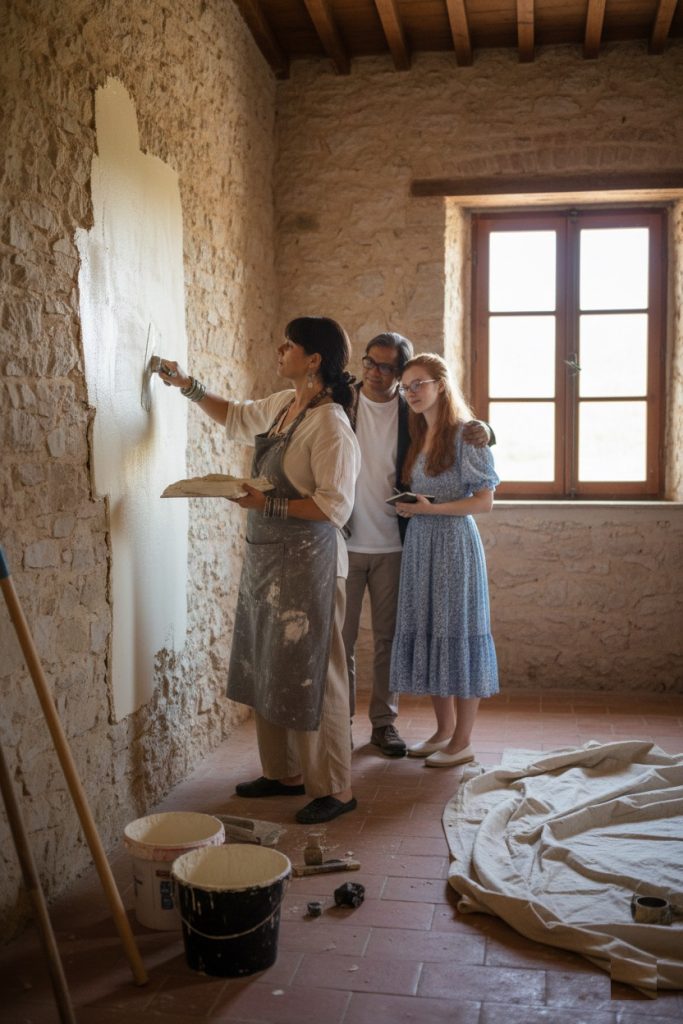
“Colour,” Komal announced one morning. “You need colour.”
She mixed pigments from local earth—ochre from the hills near Agrigento, umber from the forests of Nicosia, a soft grey that matched the lichen on ancient walls. Lilly chose a warm terracotta for the kitchen, a colour that echoed the clay of their garden soil. Zane, to everyone’s surprise, selected a deep sage green for the study.
“Reminds me of Peshawar,” he said. “My grandmother’s house had a room this colour. I used to read there for hours.”
Lilly squeezed his hand.
The day Komal left, she handed them a small jar of pigment. “For your next project,” she said. “You’ll know when.”
“What is it?” Zane asked.
“Sicilian blue. From the sea near Cefalù. Very rare, very particular. It only works in the right light.” She smiled. “I suspect your house will know what to do with it.”
They watched her Panda disappear down the gravel road. The house stood behind them, silent and patient.
“She was right,” Lilly said. “About the lime.”
“She was right about everything.”
Lilly turned to face him. “Are you going to miss her?”
“Yes,” Zane said honestly. “But missing people is part of having them in your life. That’s not a loss. That’s a continuation.”
“Also something she said?”
“Actually, that one was you. The night before our wedding, when I was panicking about my parents’ flight being delayed.”
Lilly laughed. “I don’t remember that.”
“I do. You said, ‘Delay isn’t absence. They’ll get here eventually, and the missing them in between is just proof that they matter.'”
“That’s very wise.”
“You’re very wise.”
“Occasionally. When the situation demands.” She took his hand. “Come on. We have a date with Calogero and a very suspicious cloud formation.”
CHAPTER 12
The Symphony of Systems
Calogero was, by his own admission, “a man at war with the sky.”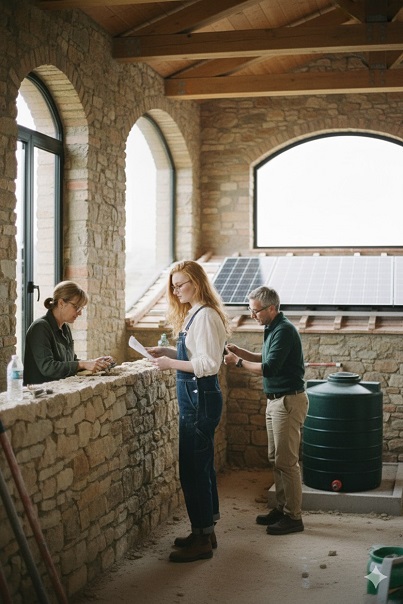
His feud with clouds was legendary in Mussomeli. He had been known to abandon lunch mid-bite to adjust his own solar panels during a sudden break in overcast weather. His van, a Fiat Ducato with 300,000 kilometres on the odometer, bore a hand-painted licence plate frame reading: IL SOLE VINCE SEMPRE—THE SUN ALWAYS WINS.
“They’re mocking me,” he announced, glaring at the wispy cirrus drifting lazily over their roof. “Look at them. Casual. Disrespectful.”
“Calogero,” Lilly said patiently, “they’re clouds. They don’t have intentions.”
“All things have intentions. You simply don’t speak their language.” He turned his attention to the solar array, his expression softening to something almost reverent. “These panels, now. These understand me.”
The installation took three days. Carmelo, the electrician, arrived each morning precisely at seven, took one look at Calogero’s latest meteorological complaint, and retreated into silent, efficient work. Their dynamic was a study in complementary neuroses: Calogero raged at the heavens; Carmelo cursed gently at faulty wires; and between them, miraculously, a functional off-grid system emerged.
 On the third afternoon, Lilly threw the main switch.
The lights flickered, hesitated, and then blazed with steady, unwavering radiance. The water pump hummed to life, pressure building in the tank. In the garden, the drip irrigation system began its patient, life-giving work.
Calogero stood in the middle of the room, his face upturned toward the LED bulbs. “This is electricity,” he said softly. “Made from nothing. From sunlight.”
“That’s the idea,” Zane said.
“No. You don’t understand.” He turned to face them, and for once, his expression held no complaint. “My grandfather was a miner. He spent forty years underground, digging sulphur out of the dark. He never saw the sun during working hours. And now—” He gestured at the glowing bulbs. “Now I take the sun and put it into houses. This is not a job. This is redemption.”
Lilly had tears in her eyes. Zane didn’t trust himself to speak.
Carmelo, packing up his tools, paused at the door. “He’ll be insufferable about this for weeks,” he said. “The cloud complaints will be worse than ever.”
“I don’t care,” Zane said. “Let him complain. He’s earned it.”
CHAPTER 13
The Garden
Spring arrived in a rush of green, and the land demanded its due.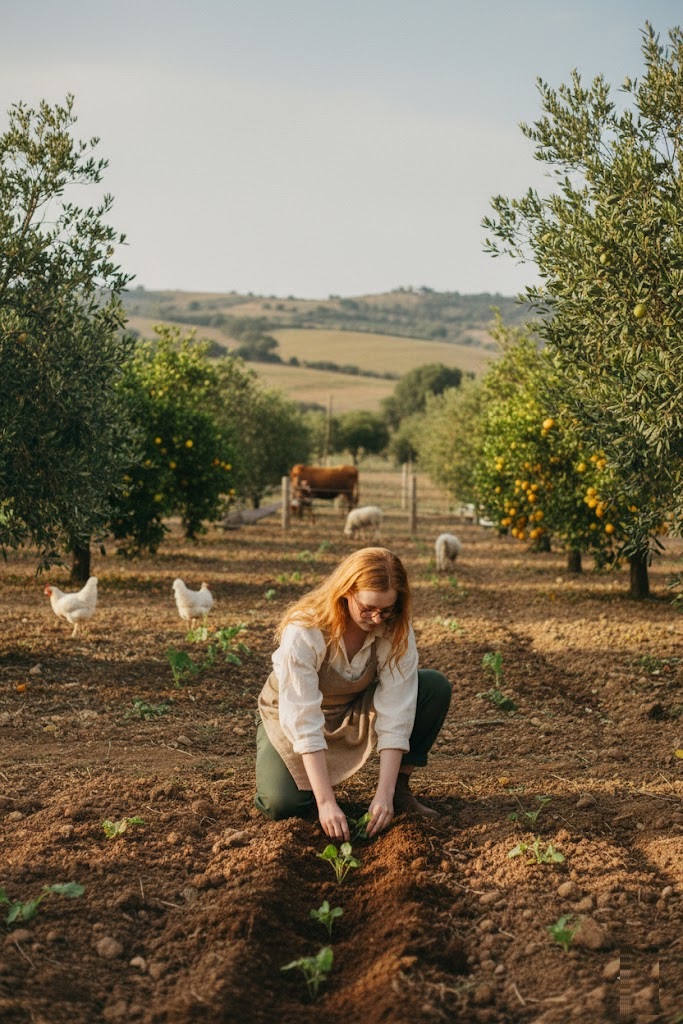
Lilly took to the task of planting some tomatoes between the rows of orange trees. Zane, inspired by Thoreau and the relentless optimism of YouTube gardening channels, threw himself into soil preparation with the intensity he had once reserved for contract negotiations. He tested pH levels, researched companion planting strategies, and constructed an elaborate spreadsheet tracking projected harvest yields.
The tomatoes responded by dying spectacularly.
“It’s not your fault,” Lilly said, surveying the wilted remains. “We gave them everything. Too much water, maybe. Or too much love.”
“The spreadsheet said they’d thrive.”
“The spreadsheet doesn’t know Sicilian soil.” She knelt, examining the pale, stunted leaves. “Giuse said the land remembers. Maybe it remembers tomatoes planted by other hands, in other centuries. Maybe it’s waiting for you to ask what it wants, instead of telling it what you need.”
Zane sat back on his heels, defeated. “I don’t know how to ask land anything. I’m a lawyer. I ask judges. I ask opposing counsel. I don’t ask dirt.”
“Then learn.” Her voice was gentle. “That’s the whole point of this, isn’t it? Learning a new language. Not Italian—that’s easy. Learning the language of stone, of trees, of soil. Of patience.”
He looked at the sad little tomato corpses, the mocking green hills, his own incompetent hands. “What if I can’t learn it?”
“Then we’ll grow something else. Or we’ll fail spectacularly and try again.” She sat beside him, her shoulder warm against his. “That’s the other thing about this life. Failure isn’t final. It’s just data.”
They planted zucchini next. The zucchini thrived with aggressive, almost vengeful enthusiasm. Within weeks, they had more zucchini than they could eat, give away, or secretly compost. Lilly started leaving anonymous baskets on neighbours’ doorsteps at dawn, like a vegetable-themed Robin Hood.
Zane, emboldened by the zucchini’s success, attempted eggplants. The eggplants, in a display of botanical spite, produced exactly one fruit, which was immediately eaten by a passing goat.
The goat belonged to a new arrival—a Sardinian family who had purchased the adjacent property and promptly installed a small herd of caprine escape artists. Their matriarch, Signora Adalgisa, arrived at Zane and Lilly’s door with a bottle of homemade olive oil and an offer to teach them about rotational grazing.
“You cannot fence goats,” she explained, as her animals calmly dismantled Zane’s herb garden. “You can only negotiate with them.”
“What do they want?” Lilly asked.
“Everything you have. And also your respect.”
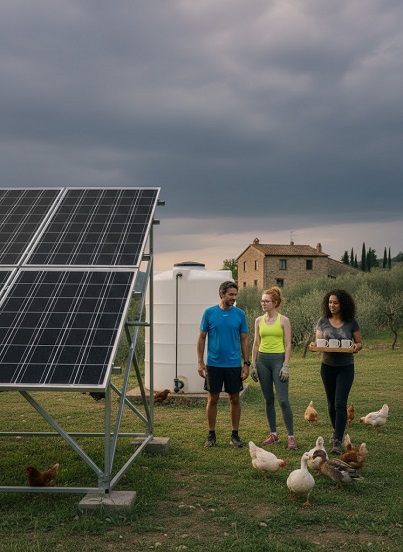
Thus began their education in animal husbandry. The chickens arrived next—six golden-brown hens who immediately established a pecking order more complex than any corporate hierarchy Zane had ever navigated. Lilly named them after Supreme Court justices, which felt appropriately dignified. Ginsburg, Sotomayor, and Kagan were productive layers. Roberts and Thomas were, according to Lilly’s detailed observational notes, “philosophically opposed to eggs.” Alito escaped into the olive grove and was never seen again.
“She’s happier out there,” Lilly said philosophically. “Free-range intellectual.”
CHAPTER 14
The Festival
The idea for the Collaborative Harvest Festival emerged, as most good ideas did in Mussomeli, over lunch.
They had gathered under Zane and Lilly’s fig tree: Elena, the young musician who had recently opened a café in the village; Salvatore, the beekeeper whose honey had won regional awards; Marco and Rose, visiting from Karachi with their newborn daughter; and the Sardinian family, whose goats had finally been convinced to respect basic property boundaries.
“The tourists come in September,” Salvatore said. “They walk through the village, take photos of the castle, eat a granita, and leave. They never see the farms. They never taste the olive oil three days after pressing. They never meet the people who actually make this place.”
“So we bring them to us,” Elena said. “A festival. Olive pressing demonstrations, honey tastings, farm tours. Music. Food. Life.”
“And whose land would host such a thing?” Adalgisa asked, her eyes sharp.
Everyone looked at Zane and Lilly.
“Our land,” Lilly said slowly. “Our olive trees. Our garden. Our… chaos.”
“It’s perfect,” Elena declared. “You have the space, the story, the international charm. People will come just to meet the Pakistani lawyer and the American teacher who bought a ruin and taught it to live again.”
Zane felt his face heat. “That’s a very romanticized description of our incompetence.”
“Romance sells,” Marco said, bouncing his daughter on his knee. “Also, you’re both extremely photogenic. Rose has been showing everyone your WhatsApp photos for months.”
“I have not!” Rose protested. Then, quieter: “Only occasionally. When the light is good.”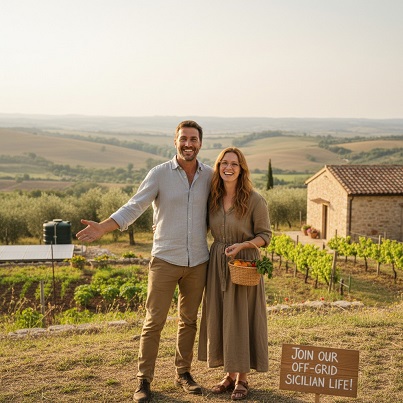
The first festival, held on a golden October weekend, was a triumph of organized chaos. Thirty-seven visitors paid for farm tours, olive pressing demonstrations, and a long lunch under the fig trees. Elena’s café provided the food; Salvatore’s honey sweetened the dessert; Adalgisa’s family contributed cheese from their goats, which had been temporarily bribed into cooperation with superior grazing privileges.
Zane, pressed into service as a guide, discovered an unexpected talent for storytelling. He spoke of their first year: the roof that leaked, the well that ran dry, the night they slept in the caravan with a menagerie of displaced wildlife. He described Giuse’s patient teachings, Calogero’s celestial feuds, Komal’s lessons in lime and pigment. He told the truth—not the polished, marketable truth, but the messy, embarrassing, glorious truth—and the visitors listened with the attention of people starved for authenticity.
At the end of his tour, an elderly woman from Bologna took his hands in hers. “Signore,” she said, “you have given me something I did not know I was seeking.”
“What is that?”
“Permission. To be a beginner. To fail and try again.” Her eyes were bright. “I am seventy-three years old. Perhaps I will buy a lemon tree.”
“Signora, you should absolutely buy a lemon tree.”
That evening, after the last visitor had driven away and the borrowed chairs had been returned to their various owners, Zane and Lilly sat on their stone steps and watched the stars emerge.
“Thirty-seven people,” Lilly said.
“Forty-three euros each, plus donations.”
“That’s not what I meant.” She leaned her head on his shoulder. “Thirty-seven people came to our farm, listened to our story, and left feeling… hopeful. That’s not nothing.”
“It’s also income.”
“It’s also income. But that’s not why we did it.”
“No.” He was quiet for a moment. “We did it because we had something to share. And because sharing it made it more real.”
The moon rose, silvering the olive leaves. Somewhere in the valley, the liberated Justice Alito goat issued a philosophical bleat.
“This is ours,” Lilly whispered. “This life. This land. This ridiculous, impossible dream.”
“MashaAllah,” Zane said.
“InshaAllah,” Lilly replied.
And the land, which had waited centuries, settled into grateful contentment.
CHAPTER 15
The Sea
The cruise was Rose’s idea.
“You’ve been working like mules for eighteen months,” she announced during a video call. “No one’s suggesting you abandon your precious olive trees, but surely they can survive a week without you. Come to Cagliari. Sabir found an incredible deal on ferry tickets. We’ll eat too much pasta, swim in water that isn’t a swimming pool, and remember what sunlight looks like when it’s not filtered through construction dust.”
Zane opened his mouth to protest. Lilly said, “We’ll be there.”
The ferry departed from Palermo at sunset, a great white ship sliding through water turned to liquid gold. They stood at the rail, watching Sicily recede into haze, and Zane felt something loosen in his chest—a tension he hadn’t realized he’d been carrying.
“When was the last time you took a vacation?” Lilly asked.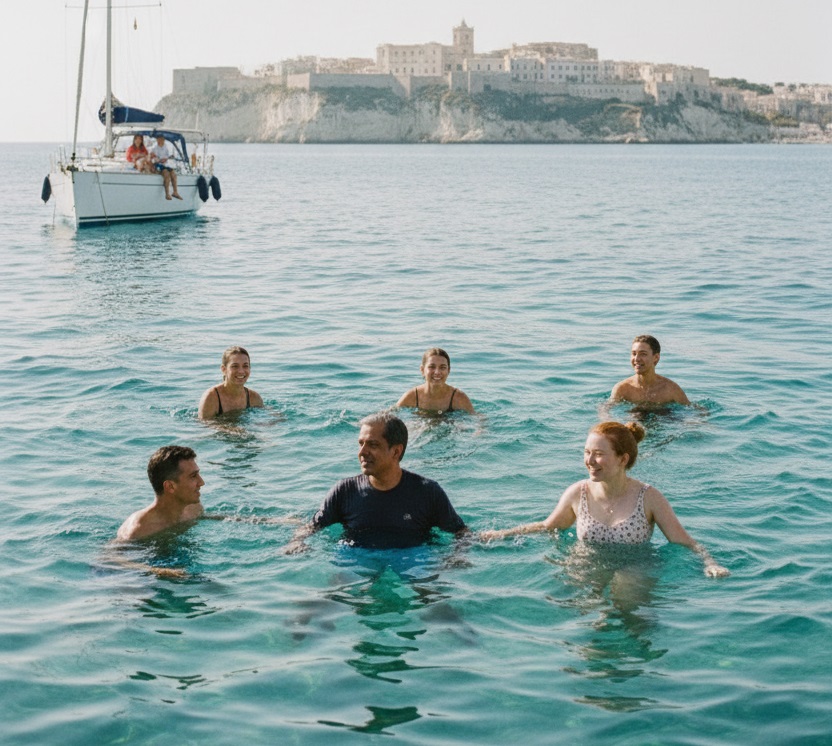
“I don’t know. Our honeymoon?”
“That was five years ago.”
“Five years and one farm renovation, one off-grid system, one vegetable garden, six chickens, four goats, and approximately ten thousand mistakes.” He smiled. “I think we’ve earned a week off.”
The sea that night was phosphorescent, disturbed by the ship’s passage into swirls of ghostly light. Lilly leaned against him, her hair salt-damp and wind-tangled.
“Do you ever miss it?” she asked. “The old life. Karachi. The firm. Being someone who wore suits and won arguments.”
“I miss Sam. I miss Zakkiya. I miss the samosas at Burns Road.” He paused. “I don’t miss being someone who wore suits and won arguments.”
“What do you miss being?”
“Someone who knew what he was doing.” He laughed, self-conscious. “That sounds pathetic.”
“It sounds human.” She turned to face him, her eyes reflecting the ship’s lights. “Zane, you’re building a house with your own hands. You’re learning a new language, a new trade, a whole new way of being in the world. Of course you don’t know what you’re doing. That’s not failure. That’s the whole point.”
“When did you become so wise?”
“I’ve always been wise. You were just too busy winning arguments to notice.”
Cagliari rose from the sea at dawn, a city of golden stone and red roofs, hills tumbling down to turquoise water. They spent four days in a kind of suspended animation: swimming in coves accessible only by boat, eating gelato on medieval ramparts, sleeping with windows open to the sound of waves.
On their last afternoon, Rose commandeered a small sailing boat from a friend of a friend, and they drifted across the Golfo degli Angeli with no destination and no schedule. Sabir, who had never entirely conquered his seasickness, lay in the bow with his eyes closed, reciting poetry under his breath. Rose steered with casual confidence, her hair a wild halo in the salt wind.
“This,” Lilly said, her face turned to the sun, “this is what I imagined when you first said Sicily. Not the permits and the plumbing and the hundred tiny crises. This.”
Zane looked at her—his wife, his compass, his improbable American-Pathan miracle—and felt the shape of his life resolve into perfect, crystalline focus.
“This is Sicily too,” he said. “The permits and the plumbing and the hundred tiny crises. And also this. It’s all part of the same thing.”
“The same thing being?”
“Being alive. Really alive. Not just moving through days until they add up to a life, but actually building something. Every day. Every mistake. Every triumph.”
Lilly smiled. “You’re getting philosophical.”
“You’re getting sunburned.”
“I’m getting glowing. There’s a difference.”
He kissed her forehead, tasting salt. “There is. I stand corrected.”
[ Chapter 1-5 ] [ Chapter 6-10 ] [ Chapter 11-15 ] [ Chapter 16-end ]