Journey of a Thousand Dreams
[ Chapter 1-5 ] [ Chapter 6-10 ] [ Chapter 11-15 ] [ Chapter 16-end ]
CHAPTER 16
The Song
Elena appeared at their door one Tuesday morning with a guitar case and a conspiratorial expression.
“I need your help,” she said. “I’m writing something for the spring festival, and it’s missing… I don’t know. Soul.”
“My soul is currently occupied with irrigation issues,” Zane said. “Can it wait until after I’ve fixed the pressure regulator?”
“It’s not your soul I need. It’s your story.” She looked past him, to where Lilly was harvesting basil. “Both of you. Your story.”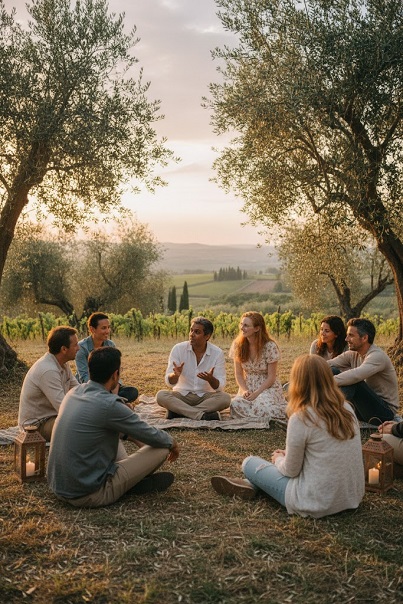
They sat under the fig tree, the guitar passed between them, and Elena asked questions that unearthed memories they hadn’t realized they’d buried. How they met. The eucalyptus trees. The first glimpse of Mussomeli from Marco’s car window. Giuse’s pronouncement about the house wanting to live. The night their solar system first powered a light.
“Describe Sicily,” Elena said. “Not the guidebook version. Your version.”
Lilly closed her eyes. “It smells like rosemary after rain. It sounds like church bells and Carmelo cursing. It tastes like Zina’s caponata and our own olive oil, which is still terrible but getting less terrible every year.”
“It feels,” Zane said slowly, “like possibility. Not the abstract kind, but the concrete kind. The kind you build with your hands.”
Elena’s fingers found a chord progression. “And love? How does love fit?”
They looked at each other.
“Love,” Lilly said, “is showing up. Every day. Even when you’re tired, even when you’re frustrated, even when the goats have escaped again and the mortar won’t set and you’re not sure if you’re building a home or just rearranging rubble. You show up, and the other person shows up, and somehow that’s enough.”
“And when it’s not enough?”
“Then you show up anyway. And wait. And try again.”
Elena wrote. The chords evolved into melody, tentative at first, then confident. By evening, she had the bones of something—a song about two strangers who crossed oceans to find each other, who planted trees in Karachi and olives in Sicily, who learned that home isn’t a place you find but a thing you build.
“It needs a title,” she said.
Lilly looked at Zane. “The Promise of Life.”
He nodded, unable to speak.
Elena played it for them one last time, her voice clear and true in the gathering dusk. The olive trees listened. The hills listened. Somewhere, in a valley four thousand miles away, eucalyptus saplings grew toward the sky, their roots deep in foreign soil.
CHAPTER 17
The Anchor
Three years became four.
The farmstead, once a collection of ambitions and architectural problems, settled into comfortable rhythm. The roof no longer leaked. The solar system hummed with quiet reliability. The garden, now mature and companionably overgrown, produced more than they could eat, preserve, or give away.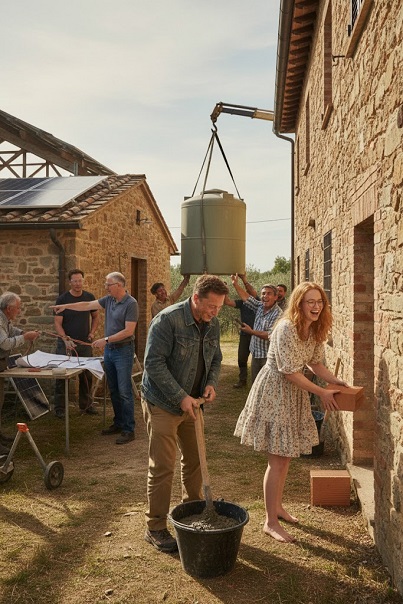
Giuse came less frequently now, his visits social rather than professional. Carmelo stopped by to check the wiring and complain about his nephew’s apprenticeship progress. Calogero’s cloud complaints had mellowed into affectionate ritual, like a priest reciting familiar liturgy.
The NayaJahan community had grown. Three new families had settled in Mussomeli, guided by AukSun’s expanding network. Zane found himself, to his surprise, acting as an informal mentor—not because he had expertise to impart, but because he had mistakes to share.
“Your first winter will be colder than you expect,” he told a newly arrived couple from Canada. “Your second winter will be warmer, because you’ll have learned how to seal the drafts and when to light the fire. Your third winter, you won’t notice the cold at all, because you’ll be too busy arguing with your spouse about whether to install a wood-burning stove.”
“And what’s the right answer?” the wife asked.
“Yes,” Lilly said, appearing at Zane’s elbow. “The right answer is always yes, because arguing about it for three years wastes more energy than the stove will ever consume.”
The Canadians looked at each other, then at Zane. “Is she always right?”
“Always. It’s exhausting and also the foundation of our marriage.”
The festival had become an annual tradition, growing from a single weekend to a fortnight of events spread across participating farms. Visitors came from as far as Japan and Brazil, drawn by articles in international magazines and the viral video of Calogero lecturing a particularly stubborn cumulus cloud.
Komal returned every few months, her palazzo renovation progressing at the pace of fifteenth-century bureaucracy. She had befriended Lilly during her second visit, the two of them bonding over shared impatience with Zane’s spreadsheet obsession. They now maintained an extensive WhatsApp correspondence devoted primarily to mocking him, which he pretended to resent and secretly treasured.
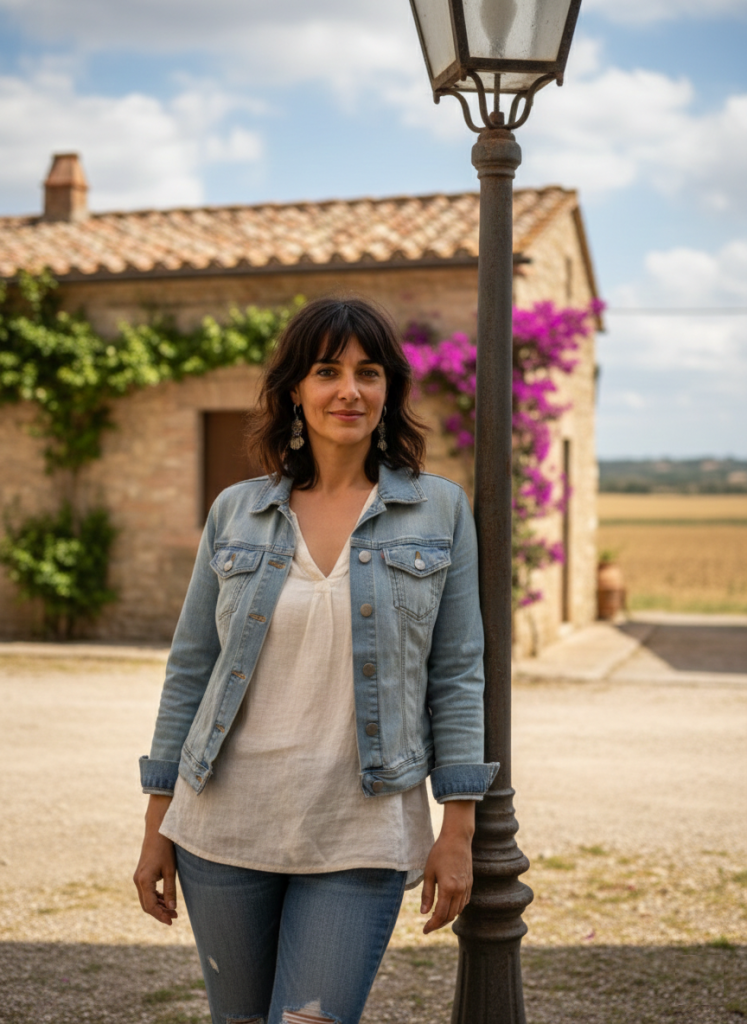
Elena’s song, “The Promise of Life,” had been recorded and streamed thousands of times; people arrived in Mussomeli asking to see the olive trees that inspired it.
“We’re famous,” Lilly said one evening, scrolling through Instagram comments. “Apparently our chickens are ‘aesthetic icons.'”
“Which ones?”
“All of them, but especially Sotomayor. Someone wants to do a photo essay on her lifestyle.”
“Sotomayor doesn’t have a lifestyle. She has a relentless commitment to egg-laying and a pathological hatred of the rooster next door.”
“Tell that to her twelve thousand followers.”
Zane set down his book. “Does it bother you? The attention?”
Lilly considered. “Sometimes. When people romanticize it—when they talk about our ‘brave escape’ or our ‘courageous simplicity.’ They don’t see the exhaustion, the boredom, the days when the only achievement is keeping everyone alive until sunset.” She paused. “But then I think about the woman from Bologna who bought her lemon tree. Or the family from Toronto who just bought their own ruin and sent us photos of the keys. And I think… maybe the romantic version matters too. Not because it’s true, but because it’s possible. It gives people permission to imagine.”
“That’s very generous.”
“That’s very pragmatic. Imagination is the first step of every real thing.” She tucked her feet under her, settling deeper into the sofa. “Also, Sotomayor deserves the recognition. She’s worked very hard.”
CHAPTER 18
The Visit
Sam arrived in October, accompanied by Zakkiya, Rose, and an extensive list of demands regarding his dietary and comfort requirements.
“I require daily access to quality espresso,” he announced as Zane helped him extract an alarming quantity of luggage from the rental car. “Also, a pillow that does not smell of goats. Also, proximity to beautiful scenery for my morning contemplative walks.”
“You don’t walk. You’ve never walked anywhere voluntarily in your life.”
“I’m a changed man. Sicily has transformed me, and I haven’t even left the car yet.”
The week that followed was a blur of laughter, overeating, and the peculiar joy of watching people you love fall in love with a place you’ve made your own. Zakkiya, who had maintained extensive notes on Sicilian speech therapy programs, spent two days visiting local clinics and returned with ambitious plans for a collaboration between PCCF and a Palermo-based audiology centre. Rose, liberated from hospital shifts, swam in the sea every morning and declared the water “medicinal.”
Sabir, who had developed an unexpected passion for bread-making, commandeered their kitchen and produced a continuous stream of loaves, focaccia, and experimental pastries. “It’s the humidity,” he explained. “Perfect fermentation conditions.”
“It’s the vacation,” Lilly said. “You’re relaxed for the first time in a decade.”
“I’m always relaxed.”
“You once filed a complaint about a delayed flight with a 47-point bulleted list.”
“That was principled advocacy, not anxiety.”
On their final evening, Sam found Zane alone on the terrace, watching the sunset stain the hills.
“This place,” Sam said, settling into the adjacent chair. “I didn’t understand it from your photos. From your calls. I thought—” He paused, uncharacteristically hesitant.
“You thought what?”
“I thought you were running away. From the pressure, the expectations, the weight of being a Pathan from Peshawar with a law degree and an MBA and a future everyone had already written for you.” He looked at his cousin. “I was wrong.”
“How so?”
“You weren’t running away. You were running to. To her. To this.” He gestured at the valley, the olive trees, the house glowing warm in the fading light. “To yourself, maybe. The self you couldn’t be when everyone was watching.”
Zane was quiet for a long time. “Do you think it was worth it? What I gave up?”
Sam’s answer was immediate. “You didn’t give up anything. You traded. You traded billable hours for sunsets, corporate mergers for tomato seedlings, the respect of strangers for the love of one extraordinary woman and a community of weird, wonderful people who argue about cloud formations and goat psychology.” He smiled. “That’s not loss. That’s arbitrage.”
“Since when are you a philosopher?”
“Since I spent a week in a place where the only urgent thing is whether the olives are ready for harvest. It changes a person.”
The sun dipped below the horizon, and the valley exhaled into twilight. Somewhere in the house, Lilly was laughing at something Rose said. The chickens were settling into their coop. Calogero’s clouds had drifted elsewhere, seeking other targets for his complaints.
“Sam,” Zane said. “Thank you. For coming. For understanding.”
“Don’t thank me. Thank the airline sale and my extremely supportive wife.” He stood, stretching. “Also, your guest room definitely smells of goats. I’m going to need that espresso first thing tomorrow.”
CHAPTER 19
The Winter
The fifth winter was the hardest.
Not because of weather—the season was mild, with more sun than cloud and only one significant storm. Not because of work—their systems were mature, their skills established, their routines reliable. Not because of isolation—the NayaJahan community had grown to include families across three valleys, and there was always someone to call for coffee or consolation.
It was hard because Lilly’s father died.
The call came at 3 AM, the sound of her mother’s voice fractured across six thousand miles of cable and satellite. A heart attack, sudden and absolute. No warning. No chance for goodbye.
Zane held her through the night, through the hours of shock and the days of logistics, through the brutal calculus of international death: the flights, the visas, the impossible distance between Sicily and North Dakota. He booked her ticket before dawn, packed her bag, called Marco to explain.
“I should come with you,” he said.
“Your visa application is still processing. You can’t leave Schengen.” Her voice was hollow, automatic. “Also, someone needs to feed the chickens.”
“The chickens can survive a week without me. You can’t.”
“I can.” She looked at him, and something in her face shifted—grief hardening into determination. “I have to. My mother needs me to be strong, and I can’t be strong if I’m worried about you being stuck in immigration limbo. Stay. Hold the fort. I’ll come back.”
“Promise?”
“Promise.”
She was gone for three weeks. Zane measured time in the small, desperate rituals of solitary existence: morning coffee for one, evening meals eaten standing over the sink, phone calls timed to bridge the gap between Sicily’s night and North Dakota’s day. He talked to Giuse about stone. He let Calogero complain about clouds without offering his usual gentle mockery. He sat under the fig tree and tried to remember the shape of his life before Lilly, when solitude was a preference rather than an absence.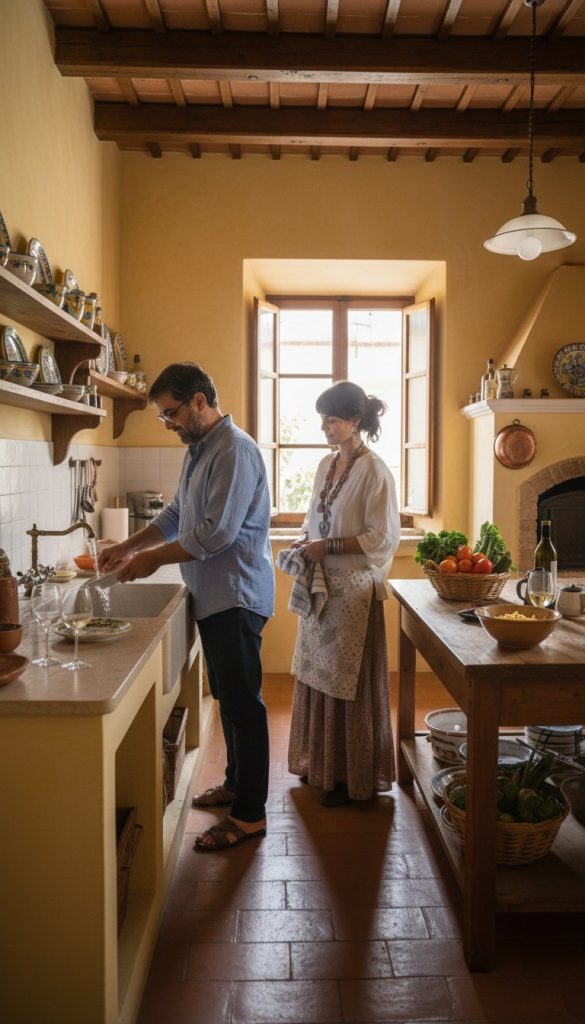
Komal arrived unannounced on the tenth day, took one look at him, and began cleaning his kitchen with aggressive efficiency.
“You’re not helping,” she said, scrubbing a pan that had been soaking since Tuesday. “You’re surviving. There’s a difference. Survival is keeping the body alive while the soul figures out where it’s supposed to go.”
“And you’re helping how?”
“I’m making space.” She rinsed the pan, set it in the drying rack. “Grief needs room. It needs clean surfaces and fresh air and food that isn’t reheated leftovers. It needs someone to say, ‘Yes, this is terrible, and also you will survive it.'”
“How do you know?”
She paused, her hands still in the soapy water. “I buried my spouse twelve years ago. In Karachi, in February, under grey skies that matched everyone’s mood. I thought the grief would drown me. Instead, it taught me to swim.” She pulled the plug, watched the water drain. “You don’t forget. You don’t stop missing them. But you learn to carry the weight differently. It stops being a burden and starts being… ballast. Something that keeps you steady when the waves get rough.”
Zane didn’t know what to say. He had never asked Komal about her past, had assumed her solitary life was a choice rather than a consequence.
“His name was Shah,” Komal said. “He was an archaeologist. He taught me that ruins aren’t endings—they’re transformations. Something becomes something else. The shape changes, but the story continues.” She dried her hands, folded the towel slowly and precisely. lost in thoughts that emerged. “Your Lilly will come back. She will be different. So would you. And your story will continue, because that’s what stories do.”
She left before he could respond, her footsteps fading down the gravel path. Zane sat in his clean kitchen, surrounded by the evidence of her care, and let himself cry for the first time since Lilly left.
CHAPTER 20
The Return
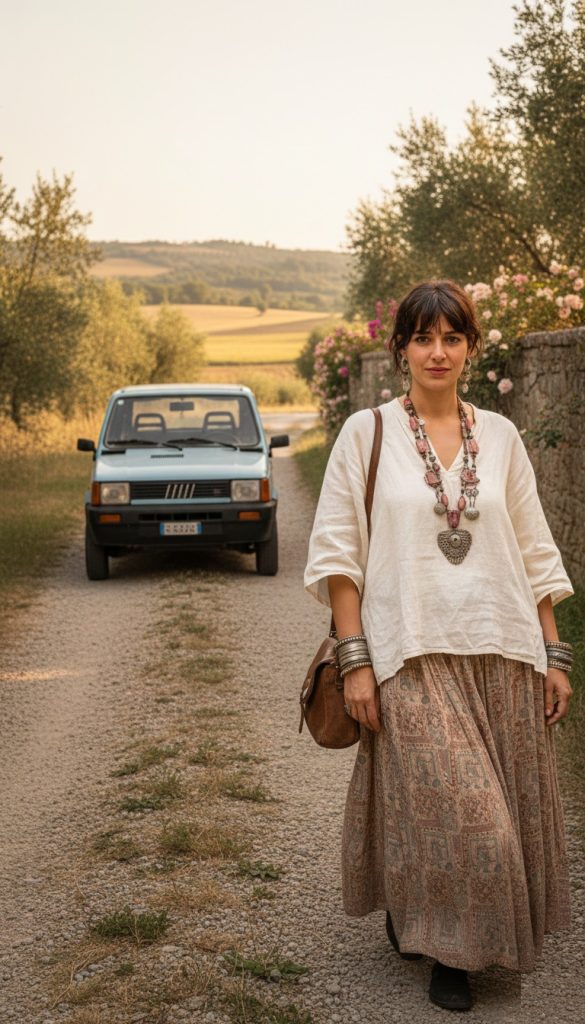
Lilly came home on a Thursday.
Zane saw the taxi from the terrace, its dust plume rising like a signal fire. He was down the path before it stopped, through the door before she could pay the driver, his arms around her before she could speak.
“I’m covered in airplane,” she said into his shoulder. “I haven’t showered in eighteen hours. I think I ate a pretzel that was older than our marriage.”
“I don’t care.”
“I have my mother’s pie plate in my carry-on. It’s very fragile and also digging into my kidney.”
“I don’t care.”
She pulled back slightly, just enough to see his face. “Zane. I’m okay. We’re okay. It’s terrible and it will always be terrible, but we’re okay.”
“You’re okay?”
“I will be.” She touched his cheek, her fingers cold from the taxi’s air conditioning. “I have a lot of practice, remember? Losing things. Learning to carry them differently.” Her smile was small but genuine. “Komal called me. In North Dakota. She said you needed to hear that ruins aren’t endings.”
“I did. I do.”
“She also said you’ve been living on espresso and anxiety, and that I should make you eat a vegetable.”
“The garden produced an eggplant. It was very brave and also inedible.”
“Then I’ll make you something else.” She took his hand, led him toward the house. “I brought recipes. My grandmother’s potato salad. My mother’s meatloaf. My father’s—” Her voice caught, steadied. “My father’s chili. He won third place in the county fair, 1998. He was so proud.”
“I would love to learn your father’s chili.”
She nodded, once. Then she walked through the door of their home, into the kitchen where the light was golden and the counters were clean and the man she loved was waiting to learn the language of her grief.
CHAPTER 21
The Fig Tree
Spring came gently that year, as if the land understood they needed time to heal.
The olive trees produced abundantly, their fruit ripening into oil that—for the first time—Zina pronounced “acceptable.” The goats, in a shocking display of interspecies diplomacy, formed a tentative alliance with the chickens, sharing grazing territory with minimal territorial disputes. Even Calogero’s clouds seemed less adversarial, drifting through with benign indifference rather than malicious intent.
Lilly spent hours under the fig tree, reading, sketching, sometimes just sitting with her hands in the soil. She didn’t talk much about her father, but she didn’t need to. Zane understood that grief was not a problem to be solved but a presence to be accommodated, like a new piece of furniture that slowly, imperceptibly, became part of the room’s natural arrangement.
One afternoon in late April, she called him from the garden.
“I want to plant something,” she said. “For him.”
“What did he love?”
She thought for a moment. “Trees. He was a high school biology teacher, and every year he’d take his students to plant saplings in the conservation area. Oak, mostly. Maple. Sometimes pine.” She touched the fig’s rough bark. “I don’t think figs grow in North Dakota.”
“We could try. Protect it through the winter. Keep it in the greenhouse until it’s strong enough.”
“You think it would survive?”
“I think,” Zane said carefully, “that trees are like people. They need the right conditions, but they also need someone who believes they can thrive.”
They ordered a sapling from a nursery in Palermo—a variety called Fico Bianco del Cilento, known for its resilience and its honey-sweet fruit. Lilly planted it at the edge of the olive grove, where it would receive morning sun and afternoon shade. She watered it with the same patient attention she brought to everything she loved.
“This is for you, Dad,” she whispered, patting the soil around its base. “It’s not oak. It’s not North Dakota. But it’s mine, and it’s beautiful, and I think you would have liked it here.”
The sapling swayed in the breeze, settling into its new home.
CHAPTER 22
The Circle
The sixth Harvest Festival coincided with the first fruit of Lilly’s fig tree.
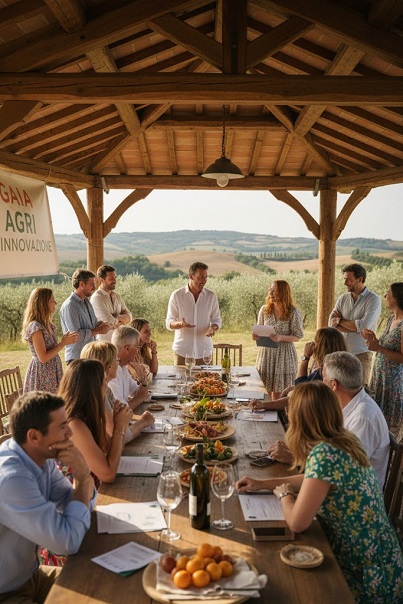
It was a small harvest—barely a basketful—but the figs were perfect: purple-striped, honey-sweet, warm from the sun. Lilly arranged them on a wooden platter and placed them at the centre of the long table under the pergola.
Elena arrived with her guitar and a new song, inspired by the story of a girl from North Dakota who crossed oceans to plant trees in two continents. Salvatore brought honey from his healthiest hives. The Sardinian family contributed cheese and a surprisingly heartfelt apology for the continued philosophical objections of their goats.
Komal came, her palazzo finally restored after six years of bureaucratic combat. She surveyed Zane and Lilly’s kitchen with approving eyes—the terracotta walls, the sage-green study visible through the open door, the small jar of Sicilian blue pigment waiting on the windowsill for a project that would know when to begin.
“You’ve done well,” she said. “The house is proud of you.”
“It’s just plaster,” Zane said, but he was smiling.
“It’s never just plaster.”
Carmelo arrived with his new apprentice, a silent young woman from Agrigento who had already mastered the art of the disappointed sigh. Calogero came, glanced at the sky, and—miraculously—said nothing.
Giuse came last, moving slowly now, his cane tapping a familiar rhythm on the stone path. Lilly pulled out a chair for him in the shade, poured him water from their well, placed a plate of figs within easy reach.
“The house is complete,” he said. Not a question.
“It will never be complete,” Zane said. “You taught us that. A house is a conversation, not a project.”
Giuse nodded slowly. “And the conversation continues?”
“Every day.”
“Good.” He selected a fig, examined it with the same attention he had once given their walls. “This is what I hoped for you. Not the house. Not the land. The continuation.”
The afternoon stretched into evening, golden and unhurried. Elena played her songs. Rose and Sam, visiting again, debated the correct proportion of basil to pine nuts in pesto. Zakkiya, who had finally established her Palermo audiology partnership, showed everyone photos of her new clinic. Sabir distributed focaccia. Adalgisa’s goats, sensing the concentration of food and attention, launched a coordinated assault on the herb garden and were repelled with dignity intact.
As the sun set, painting the hills in rose and amber, Zane looked at the table full of people—his people, his community, his improbable family—and felt the shape of his life resolve into perfect, peaceful clarity.
Lilly took his hand under the table.
“Happy?” she asked.
“Alhamdulillah,” he said.
“InshaAllah,” she replied.
And the land, which had waited centuries, which had crumbled and been rebuilt, which had known abandonment and resurrection, settled into the warm embrace of those who had chosen to call it home.
EPILOGUE
The Next
Morning light touched the olive leaves gently.
Zane walked the familiar path to the orchard, his pace steady, his heart quiet. No checklist. No urgency. Just the simple satisfaction of moving through a world he had helped create.
Lilly was already in the kitchen, preparing tea. Through the window, he saw a small car approach the gate, its dust plume rising like a question mark. Newcomers. Nervous and hopeful, clutching printouts and laptops and dreams that had not yet encountered the clarifying friction of reality.
Zane smiled.
“It is,” he would tell them, when they asked if this life was possible. “But it takes patience. And help. And the willingness to fail in increasingly creative ways.”
Lilly would bring tea, and figs from her tree, and the quiet confidence of someone who had crossed oceans and buried parents and learned that home is not a place you find but a thing you build, every day, with your own two hands.
Giuse would appear, drawn by the gravitational pull of those who needed his wisdom. Carmelo would wave from the shed. Calogero would glare at the sky, then at the newcomers’ hopeful faces, and mutter something about clouds that was really an invitation.
And the circle would continue.
Somewhere, in a city apartment or a suburban house or a village on the other side of the world, someone else was opening a laptop. They were scrolling through property listings, researching visa requirements, calculating solar panel wattage and the cost of imported olive trees. Their heart was beating with the same terrified, beautiful question that had once driven Zane and Lilly across oceans:
Is this life possible?
The answer was waiting for them.
In the hills of Sicily, under the patient gaze of ancient olive trees, a couple was walking their land. Their house stood solid and warm. Their garden was abundant. Their community gathered at their table.
And the fig tree Lilly had planted for her father was heavy with fruit, ready for the next harvest, ready for the next story, ready for the next person brave enough to believe that some promises are worth the crossing.
NayaJahan.
New world.
It had always been waiting for them.
It is waiting for you.


THE END
(to take a hands-on experience of this story, you may take the Living Off-Grid in Sicily program).
[ Chapter 1-5 ] [ Chapter 6-10 ] [ Chapter 11-15 ] [ Chapter 16-end ]