Lilly came up beside him, drying her hands on a towel. “Do you think they’re planning a midnight fig heist?” she whispered, amused.
Zane chuckled. “I don’t think so. It’s not theft they’re after. It’s… inspection. And maybe a little inspiration. Or confusion.”
Just then, Zina arrived, not with opinions this time, but with action. She carried two large baskets overflowing with San Marzano tomatoes, their crimson skin glowing in the late sun. “Sentite,” she said, Listen. “The pomodori are too many for you. The fichi will be too many next month. You have a story here—the story of this land coming back to life. People want to see this. We,” she gestured between them, “can host a workshop. Next week. Simple.”
The idea, once spoken, took root instantly. That evening, over a map of their farm, they sketched a plan:
When they mentioned the evening event, Carmelo and Calogero immediately launched into a passionate debate about ambient lighting. “Solar-powered string lights!” “No, traditional luminarie with candles!” “Fire hazard!” “Romantic!” Giuse listened, then silenced them with a raised hand. He looked at Zane and Lilly. “Condividendo, si piantano radici. By sharing, you plant roots. For trees, yes. But more importantly, for the heart. This is how a place becomes more than a plot.”
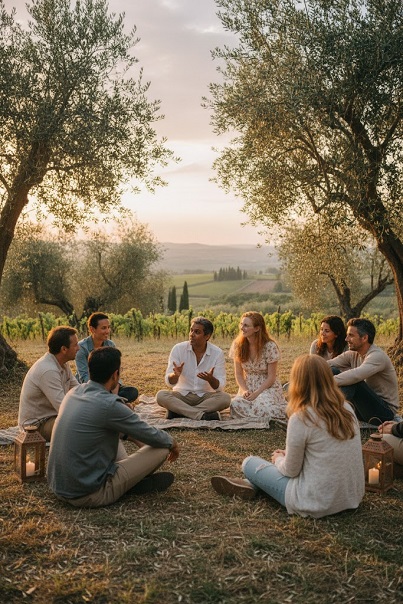
They decided to host a trial run with two other families from the NayaJahan network—a couple from Germany restoring a vineyard, and a family from the UK with a passion for natural building.
The weekend was a beautiful, controlled chaos. There was laughter as a child accidentally sat in a basket of figs. There were earnest discussions about solar battery sizes over shared meals. There was the magical moment on the final evening, as the solar-powered fairy lights (Carmelo’s grudgingly installed compromise) twinkled on, and stories were shared—not just of Sicily, but of Lahore, London, and Berlin.
As the last guests drove off, Zane put his arm around Lilly. The quiet of the land returned, but it felt different now; it was a quiet that echoed with recent laughter. “This… this feels bigger than just us two,” he whispered.
Lilly leaned her head on his shoulder, looking at the stars now dominating the sky. “It is, jaan. It’s life. Not just our little contained life. It’s messy, it’s joyful, it’s… shared.” The farm was no longer just their private sanctuary. It had become a living node in a growing, supportive community. It belonged to a story much larger than their own.
Living off-grid doesn’t mean living in isolation. It can mean curating connection and creating micro-economies that deepen your roots.
1. Agriturismo: The Legal Pathway to Sharing
You cannot just list a room on Airbnb if your property is classified as agricultural land. The regulated, legal framework is Agriturismo.
Registration: You must register your activity with the regional government and the chamber of commerce.
Compliance: Buildings must meet specific safety codes. You need liability insurance.
The 51% Rule: A key principle is that the primary income of an agriturismo should theoretically come from farming, with hospitality as a complementary activity. Your tomatoes and olive oil are your credentials.
2. Designing Experiences, Not Just Stays
People come for the authenticity. Your value is your real, mud-on-your-boots life.
3. The Privacy-Visitor Balance: Zoning Your Land
To avoid feeling like a zoo exhibit, design your space intentionally.
4. The Power of the NayaJahan Network
This is your secret weapon. The network connects you with others on the same journey.
☐ Research Local Agriturismo Regulations. Your geometra or the local ufficio turismo can provide the specific checklist for your comune.
☐ Define Your “Farm Story.” What is the unique narrative of your land and skills? (e.g., “From Karachi Office to Sicilian Orchard”).
☐ Design One Pilot Workshop. Pick one thing you do well (baking bread in an outdoor oven, pruning fruit trees) and structure a 3-hour experience around it.
☐ Connect with 2-3 NayaJahan Members. Brainstorm collaboration ideas. Can you create a combined “Off-Grid Sicily Trail” for interested visitors?
☐ Prepare Your Space & Yourself. Set up a guest bathroom, plan simple catering, and mentally prepare to open your world a little.
To legally host paying overnight guests on agricultural land in Sicily, what is the primary regulatory framework you must work within?
A. A standard business license (licenza commerciale).
B. The registered agriturismo framework, which ties hospitality to agricultural activity. ✅
C. Simply obtaining permission from your nearest neighbor.
D. No framework is needed if you use online platforms like Airbnb.
How can engaging in community projects and agro-tourism benefit your core off-grid farm life?
A. It only reduces your privacy and adds work.
B. It can provide supplemental income, deepen social connections, and create a supportive local network, enriching your life. ✅
C. It allows you to replace farming entirely with tourism income.
D. It is merely a decorative activity to make the farm look busy.
What is a crucial tip for starting your first agro-tourism or community project?
A. Invest heavily in marketing and infrastructure before testing the idea.
B. Start with a small, simple pilot project to gauge interest and refine your offering based on real feedback. ✅
C. Invite as many people as possible for a large launch event.
D. Keep all ideas secret to avoid competition.
To go to the next lesson, click Next.