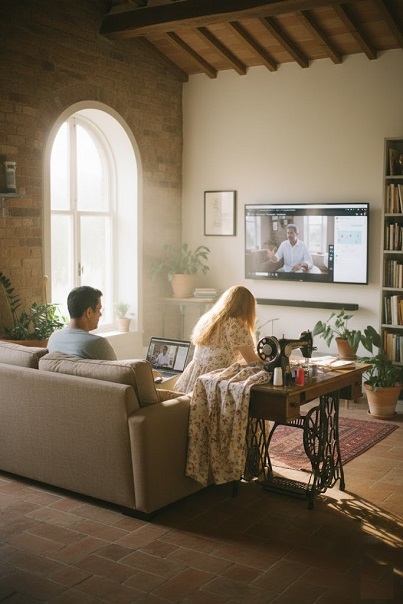
Zane sat attentive on their old almond sofa, a laptop balanced precariously on his knees. On the screen was a online diagram of water flow rates and pressure differentials. “Lilly,” he said, his voice a mixture of awe and frustration, “who knew that designing the perfect drip irrigation line required solving for X? I feel like I’m back in school, but the final exam is whether our tomatoes live or die.”
L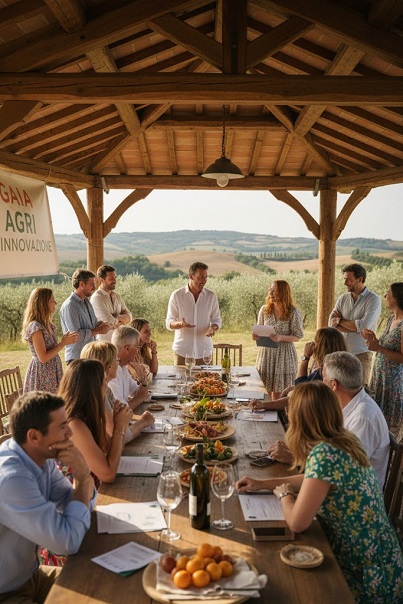 illy didn’t look up from her sewing machine, steadily sewing a flowery apron. “And who knew,” she replied, a smile in her voice, “that I would get more satisfaction from sewing a straight seam on this apron than from closing a corporate deal? The stakes feel higher. If this seam fails, my clothes get dirty.”
These were their new home-schooling online classrooms! How exciting. In the quiet hours between dawn chores and the intense heat of the afternoon, they would either take a siesta or log into pccf.auksunlms.com, the learning platform AukSun had developed. They found a new friend Rosaria from Puglia, who introduced them to a campus for online events-palazzodeicedri.it/. These two sites were their online library, a hub for conferences, exhibitions, a co-working restaurant all rolled into one.
Zane dove into modules with titles like “Soil Science Fundamentals” and “Renewable Energy System Maintenance.” Lilly explored “Food Preservation Techniques” and “Practical Textile Arts.”
One morning, Giuse found them like this—Zane muttering over pH levels, Lilly practicing a blanket stitch. The old mason leaned on his cane, watching. “Gli umani che imparano mentre la terra riposa. Curioso, no?” Humans learning while the land rests. Curious, isn’t it? “The land teaches by doing. You are teaching yourselves by thinking. Both are necessary for a wise farmer.”
Even Carmelo, stopping by to check an inverter connection, peered over Zane’s shoulder at a wiring schematic on the LMS. He grunted, a sound that was almost impressed. “Hmm. Questi diagrammi… These diagrams. I think I just learned a better way to explain a parallel circuit to my nephew. From a website.”
Calogero, shown Zane’s self-drawn troubleshooting flowchart for the solar system, merely scowled at a non-existent cloud and said, “Good. Now you will bother me less with simple questions.” It was the highest praise he could muster.
Their days settled into a rich, self-directed rhythm:
One evening, as fireflies sparked to life, Lilly looked around. The orchard wasn’t just producing fruit; it was buzzing with ideas. A half-built cob oven for baking, a newly repaired chicken coop door, her own hand-sewn sunhat on the bench. She smiled at Zane. “We’re our own students here. And our own teachers.”
Zane put an arm around her, pulling her close. “And the farm,” he said, gazing at their land, “is the most beautiful, demanding, and rewarding classroom we could ever have.”
Learning had ceased to be a separate task. It had become the very fabric of their fun, immersive, and endlessly rewarding new life.
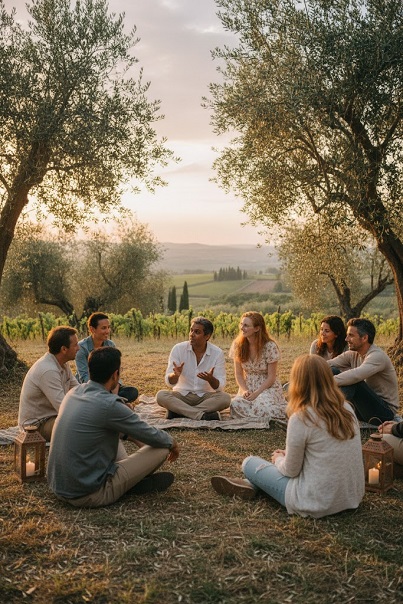
The off-grid mind must be as fertile and adaptable as the soil. Structured self-education turns daily challenges into mastery.
1. Designing Your Scuola della Terra (School of the Land)
Forget rigid semesters. Learning here is cyclical and integrated.
The Daily/Weekly Rhythm:
Morning (Hands-On): Farm Chores. This is applied science—animal behavior, plant pathology, meteorology.
Late Morning (Minds-On): Structured Study. 60-90 minutes of focused time on pccf.auksunlms.com. This is when you learn the why behind the what.
Afternoon (Integration): Skill Session. Directly apply the morning’s theory. Watched a module on pruning? Go prune. Learned about seam finishes? Finish that apron.
Evening (Reflection): Journal & Plan. The most critical step. Note observations, questions, and tomorrow’s learning focus.
2. Your Digital Homestead Library: pccf.auksunlms.com
This platform is your knowledge hub, designed for the off-grid learner.
Structured, Progressive Modules: Not random blogs, but courses that build knowledge: “From Seed to Seed Saving,” “Introduction to Off-Grid Electrical Systems,” “Natural Building Materials.”
Offline Accessibility: Download modules when you have internet to study later under your almond tree.
Practical Exercises & Tracking: It includes worksheets, project plans, and progress tracking, turning abstract knowledge into actionable steps.
3. From Theory to Toolbox: Skill Integration in Action
Learning is not an academic exercise; it’s a survival and thrival strategy.
Textile Arts (Sewing, Knitting): Start by mending work clothes. Progress to making canvas tool rolls, knitting warm socks for winter, or sewing curtains from old linens. This is functional creativity.
Digital Literacy: Use spreadsheet modules to track egg production or solar input/output. Learn basic graphic design to create simple flyers for your agro-tourism workshops. Use communication tools to stay connected with the NayaJahan network.
Craft & DIY: A module on basic carpentry leads to building a raised bed. A lesson on ceramics could inspire you to make simple plant pots. Your projects solve real problems and beautify your life.
4. The Lifelong Learner’s Mindset
Embrace the “Failure” Journal: Document what didn’t work with as much detail as what did. The wilted seedlings are as important a lesson as the thriving ones.
Teach to Learn: The best way to cement knowledge is to share it. Explain composting to a visiting NayaJahan family. Your understanding will deepen.
Let Need Drive Curiosity: A broken water pump isn’t just a crisis; it’s an invitation to study hydraulic systems. Let your farm’s demands write your curriculum.
This isn’t a straight line; it’s a circle that builds competence and confidence:
☐ Audit Your Skill Gaps. What makes you anxious? Electrical work? Animal health? Preserving food? Start there.
☐ Create a Weekly Learning Schedule. Block out sacred, non-negotiable theory time, just like you schedule watering.
☐ Set Up Your pccf.auksunlms.com Account. Download your first 2-3 modules that address your top skill gaps.
☐ Start a Physical Learning Journal. Part diary, part scientific logbook. Sketch, write, paste in seed packets.
☐ Initiate a Mini-Project. Choose one small, useful item to make (a herb-drying rack, a mobile chicken tractor) that forces you to learn and apply a new skill.
What is the primary purpose of the pccf.auksunlms.com platform in the context of off-grid learning?
A. To stream entertainment videos during quiet evenings.
B. To provide structured, downloadable educational modules tailored to homesteading skills, from agriculture to crafts. ✅
C. To serve as the main social media channel for the NayaJahan community.
D. To replace all need for local tradespeople and advice.
Why is it beneficial to intentionally integrate farm chores with formal learning sessions?
A. It simply helps pass the time more quickly.
B. It creates a powerful feedback loop where theory is immediately tested and understood through real-world application. ✅
C. It allows you to avoid the harder physical work of farming.
D. There is no benefit; they should be kept separate.
What is a key advantage of keeping a detailed learning and reflection journal?
A. Primarily to decorate your bookshelf with nice notebooks.
B. To systematically track progress, analyze failures, and plan future learning based on concrete experience. ✅
C. To show to visitors as proof of how busy you are.
D. It has no practical advantage over simply remembering lessons.
Textile Arts & Sewing:
DIY & Woodworking:
To go to the next lesson, click Next.