The day of their first Farm Business Gathering dawned with the scent of Lilly’s fresh focaccia infused with rosemary from the garden and the low hum of anticipatory chatter. Today wasn’t about solitary toil; it was about weaving threads together.
Zane had arranged hay bales and wooden planks under the shade of the old fig trees, creating a rustic amphitheater. The guest list was a mosaic of their new world: Salvatore the beekeeper, his hands permanently dusted with pollen; Elena, a young musician who had traded her city apartment for a tiny café in the village; Marco, a graphic designer from the NayaJahan network with a laptop covered in stickers; two other settler families dreaming of guesthouses; and a visiting agronomist fascinated by their cooperative olive grove restoration idea.
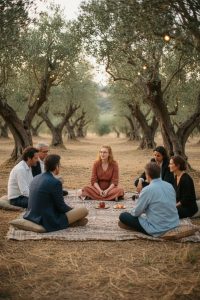
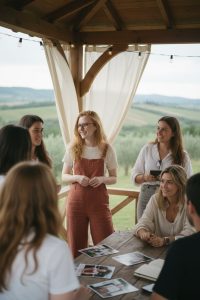
As the group settled with plates of food, the conversation began—not with pitches, but with stories. Salvatore explained how his bees loved the wildflowers on Zane’s fallow field. Elena described her dream of a “musical brunch” where the menu changed with the seasons. The agronomist, Maria, listened intently, then said, “You have separate pieces of a puzzle. The honey, the music, the food, the place to stay, the story of the land. Together, they make a complete picture for a visitor.”
“It’s not just about selling a product,” Marco the designer chimed in, gesturing with a piece of bread. “It’s about co-authoring a story. A visitor doesn’t come just for a bed. They come for an experience—the taste of local honey at breakfast, the sound of a guitar in an olive grove, the chance to help harvest the tomatoes for their dinner.”
Excitedly, they began sketching on a large sheet of paper taped to an easel. Lines connected ideas into a beautiful web:
Elena’s Café would source vegetables from Zane & Lilly’s garden and honey from Salvatore’s apiary.
The British family’s guesthouse would offer their guests a “Farm Experience Package” that included a workshop at Zane & Lilly’s and a reserved table at Elena’s.
Marco would design a simple, shared website—“Mussomeli Contadino” (Mussomeli Farm Network)—listing all their offerings as one cohesive destination.
In the midst of this creative fervor, Carmelo, who had come to “supervise” and eat, accidentally elbowed a ceramic plate off the makeshift table. It shattered on the stone terrace with a spectacular crash. A moment of silence hung in the air.
Then, Carmelo shrugged, a wide grin spreading across his face. “Perfetto! That, my friends, is the sound of our first collaborative investment. We can call it ‘shared ceramic liability.’ Very modern business model.”
The group erupted in laughter, the tension broken. It was in that moment of shared humor that the most ambitious idea was born. “What about,” someone ventured, “an annual Festa del Raccolto Collaborativo? A Collaborative Harvest Festival. Right here. Music, food stalls from all our farms, workshops, olive pressing demonstrations…”
Zane’s eyes met Lilly’s across the circle, both alight with the same spark. It was bigger than a referral network. It was a community becoming an ecosystem.
As the golden Sicilian light began to soften, the gathering ended not with formal contracts, but with a shared dessert, spontaneous songs from Elena’s guitar, and a palpable sense of possibility. They had started the day as neighbors with separate dreams. They ended it as co-conspirators in a joyful, shared venture.
The Practical Guide: From Solopreneur to Co-Creator
True sustainability in a new land comes not just from self-sufficiency, but from interdependence. This is the NayaJahan ethos in action.
1. NayaJahan: The Collaborative Ecosystem
Think of it as a business guild for modern pioneers. It moves beyond networking into active cooperation.
Core Principles:
Mutual Support Over Competition: Your neighbor’s success is your marketing asset.
Barter as First Currency: Exchange skills and goods before spending scarce euros.
Shared Client Pools: A guest staying at one homestead is a potential customer for all.
Combined Buying Power: Ordering solar panels or fencing for three families gets a better price.
2. Mapping Your Collaborative Potential
Look at your farm and skills, then look around. The connections are everywhere:
Your Asset: A beautiful orchard.
Collaborative Path: Partner with a settler who is a chef (Elena) for “Fig Harvest Cooking Classes.” Partner with a guesthouse (the British family) for “Orchard Stay Packages.”
Your Asset: Proficiency in English and digital skills.
Collaborative Path: Offer to manage the shared “Mussomeli Contadino” website in exchange for a season’s worth of honey or carpentry work.
3. The Hosted Gathering: Your Launchpad
A structured but informal gathering is the fastest way to catalyze collaboration.
Step 1: The Invite List (8-12 people max): Mix locals (beekeeper, artisan) with NayaJahan settlers. Diversity sparks ideas.
Step 2: The Agenda:
Farm Tour (show, don’t just tell).
Shared Meal (breaks down barriers).
The “I Have / I Need” Round: Each person states one asset they can share and one need they have. (e.g., “I have a professional camera and need help building a chicken coop.”)
Brainstorm One Joint Project (e.g., a seasonal festival, a shared product box).
Step 3: The Concrete Next Step: Before anyone leaves, decide on ONE actionable follow-up: a WhatsApp group, a date to visit the beekeeper’s apiary, a draft of the shared website homepage.
4. Templates for Trust: Making Collaboration Tangible
To move from idea to reality, use simple frameworks:
Template A: The Co-Branding Agreement (Guesthouse + Farm Café)
The Deal: Guesthouse includes breakfast voucher for the café. Café displays guesthouse brochures and offers a 10% discount to guests who show a room key.
The Win: Guesthouse enhances its offering; café gets guaranteed morning traffic. Shared marketing costs for a “Stay & Taste” package.
Template B: The Barter Contract
The Deal: “I, [Web Designer], will build a 5-page website for [Farmer]. In exchange, [Farmer] will provide [Designer] with a weekly vegetable box for 6 months (value approx. €XX). Both parties agree this constitutes fair exchange.”
The Win: Cash stays in pockets; needs are met; trust is built through fair exchange.
Template C: The Community Event Model
The Deal: Four farms co-host an “Olive Day.” One provides land, one handles permits, one manages food, one runs workshops. Profits are split after costs.
The Win: Larger, more attractive event with shared workload and risk. Puts your community on the map.
Your Action Checklist: Weaving Your First Collaborative Thread
☐ List Your 3 Key Assets: (e.g., spare room, welding skill, fluent Italian, a stunning view).
☐ List Your 3 Pressing Needs: (e.g., website, help with harvest, marketing photos).
☐ Host a Micro-Gathering: Invite 3-4 people for coffee. Use the “I Have / I Need” format.
☐ Propose One Simple Barter: Offer something small and specific to test the model.
☐ Create a Shared Vision Board: A simple online doc or physical board where members can post assets, needs, and ideas.
Knowledge Check
What is the core essence of the NayaJahan collaborative business model?
A. Fierce competition to drive individual success.
B. Isolated self-sufficiency without external input.
C. Sharing resources, skills, and client referrals to build a supportive, interlinked ecosystem. ✅
D. Solely focusing on individual promotion and marketing.
What is a highly effective first practical step to explore business collaboration?
A. Registering a formal corporation immediately.
B. Hosting an informal farm gathering with neighbors and potential partners to share ideas and assets. ✅
C. Expanding your individual business alone to prove your concept first.
D. Ignoring local community needs to focus on an online audience.
How does joint business development primarily benefit small off-grid ventures?
A. By dramatically increasing individual operational costs and complexity.
B. By building a supportive community, sharing costs and workloads, and creating shared revenue opportunities that are more sustainable. ✅
C. By reducing the need to collaborate or communicate with others.
D. By complicating every task through endless committee discussions.
ADD-ON: SAMPLE COLLABORATIVE BUSINESS TEMPLATES
(Downloadable, adaptable frameworks for your first cooperative steps.)
TEMPLATE 12A: Guesthouse + Farm Café Co-Branding Model
Purpose: To leverage complementary services, share customers, and reduce marketing costs.
The Simple Agreement: “The Guesthouse will promote the Café as its preferred breakfast venue. The Café will offer a 15% discount to guests presenting a Guesthouse key. Both parties will co-create one ‘Local Experience’ package per season.”
Key Question: What is one joint package we can launch next season?
TEMPLATE 12B: Barter-Based Collaboration Contract
Purpose: To exchange value without cash, building trust and community resilience.
The Simple Agreement: “I, _______, will provide [SERVICE, e.g., 10 hours of carpentry] to _______. In return, they will provide [GOOD/SERVICE, e.g., 6 months of weekly eggs + vegetables]. We agree the estimated value is roughly equal at €. Signed, Date.”
Key Question: What skill do I have that someone needs, and what do I need that someone has?
TEMPLATE 12C: Community Event Business Plan (One-Pager)
Purpose: To host a visible, profitable event that showcases the collaborative community.
The Simple Plan:
Event Name: Harvest Festival
Lead Coordinator: [Rotates annually]
Participant Roles: Farm A (venue), Farm B (food), Settler C (workshops), Local D (music).
Profit Share: After costs, profits split 25% to venue, 75% split equally among other core participants.
Key Question: What is one seasonal event our combined skills and lands could host?
To go to the next lesson, click Next.