(What the Land Allows, What It Forbids, and What It Gently Demands)
A Story About Listening to the Land
Giuse, a mason with hands like the roots of an olive tree and a face carved by the Sicilian sun, was their guide. He drove them in his dust-covered Fiat Panda, away from Mussomeli’s cobbled streets, down a winding strada bianca (white gravel road) that seemed to lead back in time.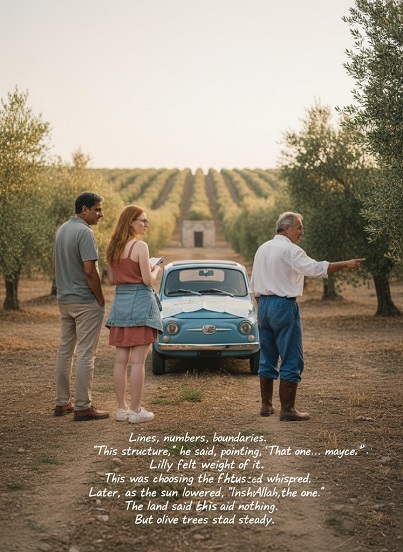
he first parcel was a sea of yellow wildflowers under a vast blue sky. It was stunning. And utterly flat. “Terreno agricolo,” Giuse said simply. “For crops. No fabbricato—no building. You could put a temporary container, maybe, with a permit that takes a year and a prayer.”
Lilly’s heart, which had leapt at the beauty, settled. It was a canvas, but they needed at least the ghost of a frame to start with.
The second plot was on a hillside. The ground was uneven, treacherous with loose stones. Stepping out, Lilly’s city sneaker slid on the gravel. She windmilled her arms with a yelp before catching her balance. Zane laughed—a deep, free sound that echoed off the valley—and then promptly stumbled over a hidden rock himself.
They stood there, dust now thoroughly coating their shoes, laughing at their own clumsiness. Before them stretched rows of ancient olive trees, their gnarled trunks silver-grey in the light, leaves whispering in the gentle breeze. The air smelled of dry earth, wild thyme, and permanence.
“This feels… alive,” Lilly said, her voice hushed.
Giuse stood quietly beside them, letting the silence speak. Finally, he nodded towards the oldest tree, its trunk split and twisted like a coiled dragon. “Il terreno ricorda,” he said. “The land remembers. The Romans were here. The Arabs planted these olives. If you listen, it will tell you what to do. What it needs.”
Zane blinked, looking from the tree to Giuse. “Does it… speak English?”
Giuse’s eyes crinkled into a smile. “No. But it understands patience. And respect. And the language of water.”
Just then, a car pulled up, kicking up a plume of dust. It was Salvatore, SunSicilia’s local contact, a folder thick with papers under his arm. “Eccoci! Here we are,” he said, shaking hands. He unfolded a large, crackling cadastral map on the hood of the Panda, using stones to hold down the corners against the wind.
“See here,” Salvatore said, his finger tracing lines and parcel numbers. “This plot, 2.3 hectares. Category: Terreno agricolo con fabbricato rurale—agricultural land with a rural building. Good. This structure here,” he pointed to a small square on the map, then to a distant, crumbling stone shell barely visible through the brush, “is legally declared. It has a catasto number. That is your starting point. That one over there…” he pointed to another pile of stones near a low wall, “…forse era una stalla, una volta. Maybe it was a stable, once. Not on the map. It does not exist in the eyes of the law. You cannot legally rebuild what the law does not see.”
Lilly felt the weight of the moment shift. This wasn’t shopping for a piece of furniture. This was archaeology, law, and agriculture all at once. They were choosing the ground upon which their future would be built, stone by patient stone.
Later, as the sun lowered, painting the hills in shades of gold and rose, Zane looked at Lilly. The quiet between them was full. He whispered, “InshaAllah, this is the one.”
The land, of course, said nothing. But the olive trees, having witnessed centuries of such hopes, stood steady and approving in the evening light.
The Practical Guide: Reading the Land’s Legal & Physical Language
In Sicily, land is not a blank, passive commodity. It is a living document—a palimpsest of history, law, ecology, and community. This module teaches you to read it.
1. The Land’s Legal Personality: Understanding Categories
Your land will have a legal classification. This is its identity, dictating what you can do.
| Category (Italian) | What It Means | The Practical Reality for You |
|---|---|---|
| Terreno Agricolo | Pure agricultural land. | Farming, forestry only. Building a new home is virtually impossible. A container abitabile (living container) requires a long permit process. |
| Terreno con Fabbricato Rurale | Agricultural land with an existing rural building. | This is often the golden ticket. You can renovate the existing legal structure. The footprint is your foundation. |
| Rudere | A ruin. | Tread carefully. Is it a legal ruin on the cadastral map? If yes, it can likely be rebuilt. If it’s an illegal ruin (not on the map), it’s just a pile of stones with no rights. |
| Agriturismo Potential | Land eligible for farm tourism. | Allows conversion/expansion of buildings to host paying guests. Comes with specific rules and business plans required by the comune. |
2. The Law of the Land: Zoning & Restrictions
Agricultural land is not residential land. This is the single most important rule.
You cannot freely convert agricultural land into residential (zona residenziale) land. The zoning plan (Piano Regolatore) is a local bible.
What you CAN typically do (with permits): Renovate legal existing structures, drill a well for agricultural use, install a solar array, build agricultural sheds (rimesse agricole).
The Golden Rule: Never Assume. Always verify with the holy trinity of local knowledge:
The Comune’s Technical Office (the final word on zoning).
A trusted Geometra (surveyor/technical consultant who manages permits).
SunSicilia’s verification team (who do the legwork before you commit).
3. Decoding the Map: The Catasto (Land Registry)
The Catasto map shows parcel boundaries, IDs (foglio and particella), and declared uses. It is a starting point, not gospel. It can be decades out of date. A structure on the map is legally recognized. One that isn’t, isn’t. This is why Salvatore’s map-check was crucial.
4. The Land’s Living Assets: Trees, Terraces, & Water
Land with century-old olive trees (ulivi secolari), almond groves, or ancient dry-stone terraces (muretti a secco) isn’t just pretty. It has:
Cultural Protection: You often cannot remove mature, productive trees without specific (and hard-to-get) authorization.
Maintenance Obligations: Abandoning an olive grove can lead to fines. The land expects stewardship.
Agricultural Identity: This history can work in your favor for certain grants or for establishing an agriturismo.
The Land Verification Flowchart: Don’t Skip a Step
Follow this path to avoid heartbreak and financial loss:
[Online Listing / Agent’s Suggestion]
         ↓
[Cadastral (Catasto) Check] ← Is the building legally there?
         ↓
[Comune Zoning Verification] ← What does the local law allow ON THIS SPECIFIC PLOT?
         ↓
[Physical On-Site Inspection] ← With a technical eye (Geometra/Giuse).
         ↓
[Informed Offer Decision]
Skipping from the listing straight to an offer is how you buy a beautiful picture of land you can’t legally live on.
Your Action Checklist: Becoming Land-Literate
Before you say “quanto costa?” (how much?):
☐ Identify the exact land category. Ask for the destinazione d’uso in the visura catastale (land registry report).
☐ Verify the legal status of EVERY structure. Is it on the catasto? Get the building ID (vani and rendita).
☐ Walk the land physically. Look for water sources, access road conditions, sun exposure for solar, and the true state of those “minor ruins.”
☐ Assess its agricultural value and obligations. Are you ready to be a guardian of an olive grove? It’s a privilege, not just a feature.
Knowledge Check
True or False: Agricultural land in Sicily can always be re-zoned as residential land if you apply for a change.
A. True
B. False ✅ (Re-zoning is extremely rare and not a realistic personal strategy. You buy land for what it is, not what you hope it might become.)
True or False: The Italian Catasto (land registry) map is always an accurate, up-to-date reflection of what is physically on the ground.
A. True
B. False ✅ (It is an administrative record that can lag decades behind reality. A physical/legal inspection is non-negotiable.)
Why is an on-site inspection with a technical expert so necessary?
A. Primarily to enjoy the beautiful scenery.
B. To confirm the legal information matches the physical reality and to identify hidden challenges or opportunities. ✅
C. Only to negotiate a lower price based on cosmetic issues.
D. To start planning the garden layout immediately.
To go to the next lesson, click Next.
AukSun’s online programs help you in your new life abroad. Book your consultation now!

Copyright 2024 AukSun Consultants, All rights reserved. Developed By Sevendot.io