The first night in their own rudere was cold. Not the life-threatening cold of a mountain peak, but a deep, damp, Sicilian winter cold that seeped up from the stone floor and whispered through the gaps where a door should have been.
They’d moved a small caravan onto the property—their “phase one” shelter. Lilly, wrapped in a blanket that felt comically thin, stared at the shadowy bulk of their future home. The wind moaned through an empty window socket. “I miss walls that don’t talk back,” she shivered.
Zane, busy trying to light a small propane heater, laughed. “They’re not talking back, dearie. They’re just saying hello. In a very… enthusiastic dialect.”
Lilly wrapped herself in a blanket. 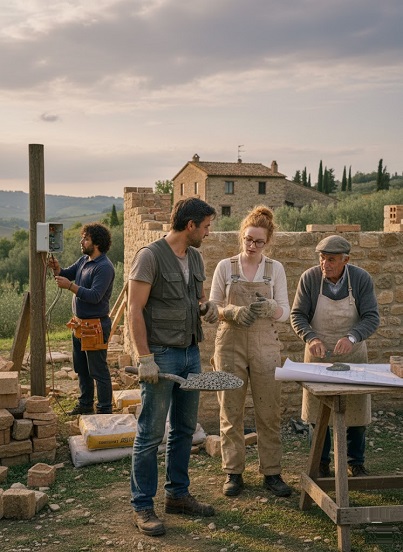
The next morning, salvation arrived in the form of Giuse’s dusty Panda. The mason stepped out, a well-worn notebook in his hand, and stood silently before the crumbling facade. He didn’t look at them first; he looked at the building. After a long minute, he placed his hand on the stone, much as he had on the olive tree. “La casa respira,” he announced. “The house breathes. You must not suffocate it with your new ideas. You must help it breathe better.”
Carmelo the electrician arrived shortly after, stomping around the perimeter, kicking at rubble. “L’elettricità dopo! Electricity later!” he declared, as if offended by the question. “First, walls that don’t fall on your heads. Then, roofs that don’t rain inside. Then we talk about lights.”
By mid-morning, Zina, Giuse’s wife, appeared as if by magic, carrying a thermos of ferociously strong coffee and a plate of impanatighe (Sicilian fried turnovers). She handed them out, her eyes missing nothing. “You see these stones?” she said, not waiting for an answer. “They are not dumb. They remember the sun’s heat from the day and let it go slowly at night. La calce—lime plaster—it lets the walls sweat, lets the humidity pass. You trust stone. You trust the old ways. Don’t wrap your house in plastic like a panino.”
Thus began their education. Days melted into weeks of dust-covered evenings. Zane, who had never held a trowel, learned the patience of pointing mortar, of waiting for lime plaster to cure, of understanding that “domani” (tomorrow) was a flexible concept. Lilly, armed with a laser level and a notebook, became the project scribe, translating their dreams into lists and measurements, mediating between ambition and reality.
They argued once, fiercely, over the placement of a window. Zane wanted it for the morning light; Lilly insisted it would ruin the structural integrity of a load-bearing wall. Voices rose, fueled by exhaustion. Then they fell silent, looking at each other’s dusty, frustrated faces. They apologized faster than the argument had flared—a lesson more important than any building technique.
One evening, as the setting sun painted the new roof tiles in shades of rose, they sat side-by-side on a half-built stone step they had laid themselves. The smell of wild rosemary filled the air. Lilly leaned her head on Zane’s shoulder. “InshaAllah,” she whispered, “this will be a home.”
Zane kissed her dusty hair. He smiled. “Tum meri jaan ho”. He looked at the solidity of the walls they had shored up, the new opening for the future kitchen, the pile of terra cotta tiles waiting to become their floor. he said softly. “It already is.”
As Zane later shared in a video update to his parents: “People ask how the build is going. I tell them, we’re not just building a house. We’re learning a language. The language of stone, of patience, and of Sicilian coffee breaks.”
Land gives you possibility. Shelter gives you stability. In Sicily, building is not a sprint; it’s a respectful dialogue with law, tradition, and the elements.
1. The Law of the Land: What You Can Actually Build
Your freedom to build is defined by the existing structure’s legal status (see Chapter 4).
Your Right: You can renovate, restore, and repair an existing legal structure (fabbricato rurale). This includes: replacing the roof (tetto), rebuilding collapsed walls, installing new floors, windows, and insulation.
The Grey Area: Internal reconfiguration is usually fine. Extending the footprint even by a few centimeters is a new construction and enters a world of complex permits (permesso di costruire) that are rarely granted on agricultural land.
The Golden Rule: Your geometra is your guide. They will submit your progetto (project) to the comune for a SCIA (Certified Notification of Start of Activity) or a Permesso di Costruire, depending on scope. Never start work without this clear guidance.
2. Phased Building: The Sanity-Saving Strategy
Trying to do everything at once is a recipe for bankruptcy and burnout. The intelligent approach is phased construction:
[Land & Legal Structure Secured]
↓
[PHASE 1: Basic Weatherproof Shell]
(Secure roof, make ONE room watertight & livable)
↓
[PHASE 2: Core Utilities Independence]
(Install water well/pump & primary solar array)
↓
[PHASE 3: Interior Comfort & Expansion]
(Insulate, fit kitchen/bath, renovate additional rooms)
Why this works: It gives you a legal, safe foothold on your land quickly. It spreads cost over time. It allows you to learn and adapt as you go.
3. The Art of Working with Artigiani (Local Trades)
Italian craftsmen are artists. This is a blessing and a cultural lesson.
Expect: Immense skill, deep pride in their work, and very strong opinions. A mason will tell you how a wall should be built. Listen.
Communication is Key: Use simple words, sketches, photos, and your smartphone translator for technical terms. A shared espresso is a more powerful tool than a complex email.
SunSicilia’s Role: We help bridge the gap. We can recommend trusted trades, help clarify scope in Italian, and manage the delicate dance of scheduling, where three jobs might be juggled simultaneously.
4. Materials: Working With the Sicilian Climate
The climate demands specific, time-tested solutions:
Embrace Breathable Materials: Stone, lime plaster (intonaco a calce), and terra cotta tiles allow moisture to transpire, preventing mold and rot.
Design for Climate: Deep overhangs (tettoie) for shade, thick walls for thermal mass, strategic window placement for cross-ventilation (spiffero).
Avoid Modern Traps: Non-breathable cement-based renders, plastic vapor barriers, and cheap insulated panels can trap humidity inside ancient walls, causing catastrophic damage. As Zina said, don’t suffocate your house.
Before you swing a hammer:
☐ Get Absolute Clarity from your geometra on the legal scope of your renovation. What is a repair vs. new construction?
☐ Create a Phased Master Plan & Budget. Know what Phase 1 must achieve (a dry room, a toilet) and what can wait (the guest bathroom, the pergola).
☐ Budget for Time. Double any timeline you have in your head. Weather, feste (festivals), and material deliveries all have their own schedules.
☐ Establish Clear, Respectful Communication with Your Lead Artigiano. They are your partner, not your employee. Daily coffee chats are project management.
True or False: On agricultural land, you are free to construct new residential buildings anywhere on your property as long as they are for personal use.
A. True
B. False ✅ (New residential construction on agricultural land is highly restricted and permit-intensive. The pathway is almost always through the renovation of an existing, legally recognized structure.)
What is the primary advantage of a phased construction approach for a homestead?
A. It allows you to avoid creating any formal building plans.
B. It manages financial outlay, reduces overwhelm, and provides a livable base from which to work legally and comfortably. ✅
C. It delays the completion indefinitely so you don’t have to pay taxes.
D. It is purely an aesthetic choice to make the build look more rustic.
Why are traditional materials like stone and lime plaster particularly well-suited to the Sicilian climate and old buildings?
A. They are the cheapest options available locally.
B. They are breathable, allowing moisture to escape, which prevents structural damage and regulates temperature naturally. ✅
C. They are the heaviest, making buildings more stable in earthquakes.
D. They are required by law for all historical renovations.
Zain shares a YouTube video:

To go to the next lesson, click Next.
AukSun’s online programs help you in your new life abroad. Book your consultation now!

Copyright 2024 AukSun Consultants, All rights reserved. Developed By Sevendot.io