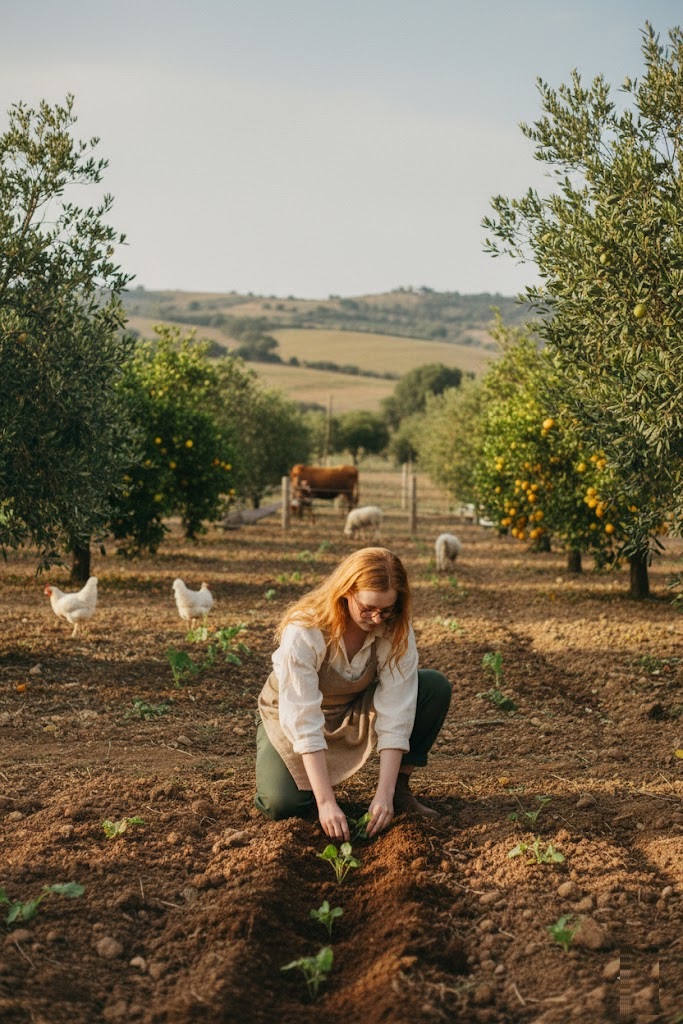
Zane, inspired by Henry David Thoreau, had a theory about simplicity. It involved less stuff and more dirt. He dug his first raised bed with a reverence usually reserved for prayer, the morning sun warming his neck, the rich, dark earth collecting under his fingernails. The grin on his face was pure joy.
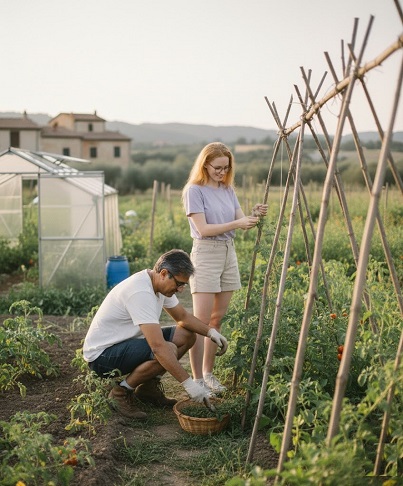
Lilly, armed with seed packets and a measuring tape, was the engineer to his philosopher. She planted the tomato seedlings with surgical precision, whispering to each one as she tucked it in. “If you survive my brown thumb,” she joked to Zane, “then we all survive here.”
Calogero arrived, ostensibly to check the solar-powered pump for the new drip irrigation lines. He stood with his hands on his hips, eyeing the neat rows of emitters. “Hmph. Water without clouds. A good trick.” He muttered something about “lazy clouds” getting replaced by machinery, but the glint in his eye betrayed his admiration for a system that worked.
Carmelo, summoned for a less explosive task, helped string a simple electric fence for the future goat pen. “Una piccola scossa per le capre, una grande pace per voi,” he winked. A little shock for the goats, a big peace for you.
Giuse Inglese watched the flurry of activity from the shade of an old carob tree, his quiet presence a calming constant. “Gli animali insegnano la pazienza,” he said softly. Animals teach patience. “You ask, they do not listen. You rush, they get sick. You watch and learn, they give you everything.”
The first livestock arrived in a perforated cardboard box that chirped. Six golden-brown hens, blinking in the Sicilian light. They tumbled out, a flurry of feathers and curiosity, immediately pecking at Zane’s shoelaces. Lilly laughed, a sound of pure delight. “Oh my God. They’re… judging our life choices. Look at their faces!”
The sheep came next—three sturdy, woolly Sardinian ewes. Zane, trying to channel the shepherds of pastoral poetry, attempted to call them. He used a gentle whistle, then a firm command. The ewes stared at him for a long moment, then turned in unison and ambled away to munch on a thistle. The lesson was immediate: this was a relationship of mutual benefit, not command.
 Days began to blur into a new, beautiful rhythm. Sunrise meant letting the chickens out and checking water levels. Mornings were for weeding and harvesting the first tender lettuce. Evenings were for securing the coop against foxes and counting warm eggs into a basket.
One evening, as the fireflies began their dance, Zane took Lilly’s hand and led her into the young orchard. The fig and pomegranate saplings were just taking hold. He didn’t say anything, just spread his arms at the view: the garden, the coop, the sheep on the hillside, their stone house glowing in the last light.
Lilly leaned into him. “Look at this,” she echoed his unspoken thought. “It’s actually ours.” She paused, then added with a smirk, “And we haven’t managed to kill anything… yet. The chickens still respect us, barely.”
It was messy. It was exhausting. It was the most grounding thing they had ever done. This wasn’t just living off the grid. This was being woven into the grid of life itself.
A home capable of functioning on its own isn’t about luxury—it’s about real autonomy. Food grows on your land, animals provide daily sustenance, water is captured and stored.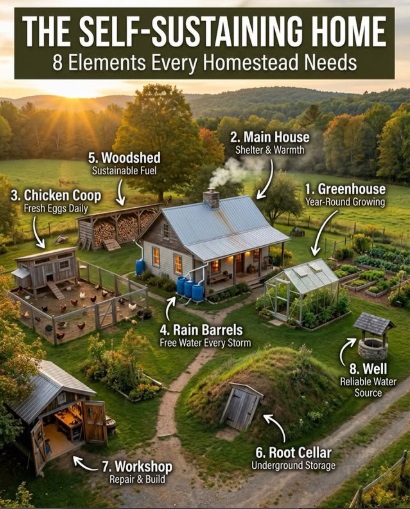
Each element serves a function. Nothing is decoration.
THE 8 ESSENTIAL ELEMENTS:
1. GREENHOUSE — Year-round growing, true self-sufficiency
2. MAIN HOUSE — Shelter, warmth, the heart of the homestead
3. CHICKEN COOP — Food security, fresh eggs daily
4. RAIN BARREL SYSTEM — Captured water for garden and household
5. WOODSHED — Sustainable fuel, stacked and seasoned
6. ROOT CELLAR — Cool underground storage, harvest lasts months
7. WORKSHOP — Repairs and projects, build instead of buy
8. WELL OR CISTERN — Reliable water source, resource independence
When you have productive gardens, well-designed systems, and a workshop ready to create or repair—home becomes a living system that supports you through any situation.
Living like this isn’t going backward. It’s going forward intelligently. True independence blooms when your land feeds you. This is the heart of the homestead.
1. The Garden: Your Daily Breadboard
Climate Champions: Focus on what thrives in Sicily’s long, dry summers:
Vegetables: Tomatoes (pomodori), zucchini (zucchine), peppers (peperoni), eggplants (melanzane), and endless varieties of greens in the cooler seasons.
Fruits: Citrus (agrumi), figs (fichi), pomegranates (melagrane), loquats (nespole), and of course, olives.
Herbs: Rosemary (rosmarino), oregano (origano), thyme (timo), and basil (basilico) will grow like happy weeds.
Intelligent Design:
Raised Beds (aiuole rialzate): Improve drainage, warm soil faster, and save water.
Crop Rotation: Don’t plant tomatoes in the same spot year after year. It depletes specific nutrients and builds up pests. Follow a heavy feeder (tomato) with a light feeder (beans) or a soil builder.
Companion Planting: Basil loves tomatoes (and may even improve their flavor). Marigolds deter nematodes. It’s a plant community.
2. Soil & Water: The Foundation
Know Your Dirt: A simple pH test kit is your first purchase. Aim for 6-7. Amend with compost (compost)—your kitchen and chicken coop will provide the feedstock.
Mulch is Magic: A thick layer of straw (paglia) or wood chips (cippato) suppresses weeds and, crucially, slows soil moisture evaporation by up to 70%.
Irrigation Wisdom: Use your Chapter 7 system! Drip lines in the garden are non-negotiable. For young trees, a slow drip from a gravity-fed tank is perfect.
3. Poultry: The Gateway Livestock
Why Chickens? Eggs, pest control, fertilizer, and endless entertainment. Start with 6-10 hens. A rooster is optional (and noisy).
The Coop (pollaio): Secure against volpi (foxes) and faine (stone martens). It needs ventilation, shade, nesting boxes, and perches. Place it close enough for easy egg collection, but not so close you hear every 5 AM debate.
4. Ruminants: Sheep & Goats
Sheep (Pecore): Ideal for wool, meat, and gentle pasture management. They are grazers, prefer grass, and are generally placid.
Goats (Capre): The browsers. They’ll clear brush you couldn’t tackle with a machete and provide milk. They are escape artists and require serious fencing.
The Universal Rule: Rotational Grazing. Move them between fenced paddocks. This prevents overgrazing, breaks parasite cycles, and fertilizes your land systematically.
5. The Next Level: Small Cattle (Piccolo Bestiame)
Consider: A miniature cow (like a Jersey) for milk, or a robust donkey (asino) for companionship and brush clearing. This is a major step up in commitment, requiring more space, water, feed, and veterinary knowledge. It’s a Phase 3 dream for most.
Think of your land as a series of interconnected zones:
This layout minimizes your daily footsteps (the “farmers’ marathon”) and creates symbiotic relationships—garden waste feeds chickens, chicken manure feeds compost, compost feeds garden.
☐ Map Your Sun & Water: Where is there full sun for veggies? Where is the water source? Plan your garden and coop accordingly.
☐ Start a Compost Pile Now: A simple bin or heap. Begin turning kitchen scraps and weeds into black gold.
☐ Build Infrastructure First: Construct the chicken coop and at least one secure pasture fence before animals arrive. Predators and escapes wait for no one.
☐ Source Animals Locally & Legally: Buy from regional farmers. Animals will be acclimated. Ensure you have the required EU movement documents (passaporto per animali).
☐ Embrace the Cycle: Plan for daily chores. Animals don’t take weekends off.
Why is it critical to practice crop rotation in your vegetable garden year after year?
A. Primarily to make the garden layout look different and pretty.
B. To maintain soil fertility and health by preventing nutrient depletion and breaking pest/disease cycles. ✅
C. Only to confuse pests, with no impact on soil.
D. There is no reason; it’s an old-fashioned practice.
What is a manageable and productive starting number of laying hens for a new homestead?
A. 1-2 hens (very small yield).
B. 3-5 hens (a modest start).
C. 6-10 hens (a good balance of egg yield and manageable care). ✅
D. 20+ hens (requires significant infrastructure and feed).
What is the primary purpose of rotating sheep or goats between different pasture paddocks?
A. So the animals don’t get bored with the view.
B. To prevent overgrazing, allow pasture recovery, and manage parasites. ✅
C. It simply makes them easier to round up.
D. It is only for aesthetic organization of the land.
To go to the next lesson, click Next.
AukSun’s online programs help you in your new life abroad. Book your consultation now!

Copyright 2024 AukSun Consultants, All rights reserved. Developed By Sevendot.io