Zane woke to the sound of Carmelo, the electrician, standing over an open circuit panel and muttering what sounded like a prayer to a patron saint of miswired junctions. It was a low, rhythmic cadence of frustration.
“Why is he always mumbling curses at inanimate objects?” Lilly whispered from under the blanket, her voice thick with sleep.
Zane smiled, watching Carmelo’s expressive hands trace the path of a rogue wire. “They don’t call them curses here, jaan. They call it ‘discussione tecnica’—technical discussion. It’s a form of Italian charm.”
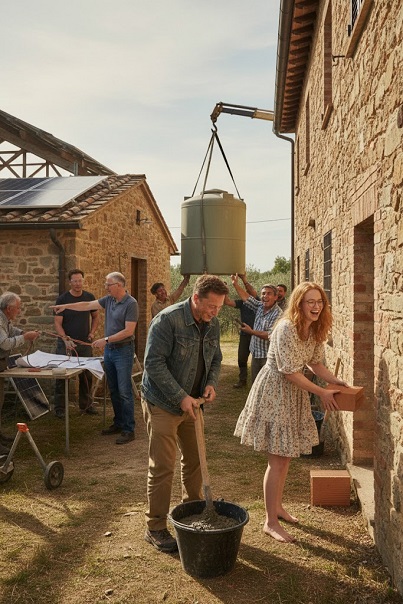
Giuse Inglese arrived a little later, as the morning light finally hit the stone wall they were repairing. He didn’t speak at first. He tapped the ancient trowel in his hand against the stone, listening to the sound. Finally, he turned. “La pietra parla lentamente,” he said. Stone speaks slowly. “So do we. If you rush, it crumbles. If you listen, it tells you how to hold it up.”
Calogero, the solar installer, pulled up in his van just as a single, puffy cloud dared to drift across the sun. He got out, pointed at it accusingly, and barked toward the roof, “I pannelli hanno bisogno di sole! Non di ombra!” The panels need sun! Not shade!
Zane, who was now well-versed in Calogero’s meteorological grievances, held up his hands in a placating gesture. “Pazienza, amico. Il sole torna sempre.” Patience, friend. The sun always comes back.
Lilly, meanwhile, had taken a different tack. She had baked a simple torta di mandorle (almond cake) that morning. She walked over to a group of older men watching the proceedings from the shade of the piazza’s bar, offering slices. One man, Salvatore, with a face like a friendly walnut, took a piece, shook her hand firmly, and gave her a wink. “Stai imparando,” he said. You are learning.
And they were. Each day was a lesson in fluid choreography. The rain came, delaying the concrete pour for the foundation. Carmelo discovered a nest of old, unsafe wiring hidden behind a wall that had to be completely redone. Calogero and Giuse had a passionate, 20-minute “technical discussion” about whether the roof pitch or the optimal sun angle should win.
Zane took Italian language course in Urdu while Lilly took Doulingo. Zane and Lilly learned to pivot. They drew diagrams on a whiteboard—silly-looking sketches of houses with arrows for wires and sunbeams. They made lists in a shared notebook, translating tasks into simple Italian phrases. They smiled through misunderstandings, learning that “subito” (immediately) could mean anywhere from 20 minutes to three days, and that the most important word in their new vocabulary was “domani” (tomorrow), which was not a deadline, but a promise of eventual continuity.
By sunset on one of those chaotic days, they stood back. The stone wall was straight and true. The new wiring ran safely in its conduits. The solar panels were a silent, gleaming array, pointed unambiguously at the now-cloudless evening sky.
Lilly, covered in a fine layer of plaster dust, took Zane’s equally dusty hand. “It’s messy,” she sighed, a contented smile on her face. “It’s so incredibly, wonderfully messy. And it’s ours.”
They had learned to laugh at the small disasters—the goat that escaped and ate Zane’s project notes, the unexpected rain shower that sent everyone scrambling. They found the humor in every cloud Calogero cursed and in every philosophical pronouncement from Giuse. The village was no longer a backdrop; it was the chorus, the audience, and sometimes, the co-director of their play.
Your solar panels and well are technical triumphs. But the network of people is what makes your life work. This is the art of social infrastructure.
1. The Trades: Your Dream Team & Their Domains
The Mason (Muratore) – Giuse: Handles stone, mortar, foundations, structural integrity. He speaks the language of load-bearing walls and the patience of lime plaster. His work comes first.
The Electrician (Elettricista) – Carmelo: Responsible for all things wire-related, from integrating your solar system to ensuring your lights don’t start a fire. He works after walls are up but before plaster goes on.
The Solar/Water Specialist (Installatore) – Calogero: Positions panels, mounts pumps, runs pipes. He needs the structure ready and the electrician’s input on connection points.
The Geometra: Your legal and technical project manager. Not a “trade” per se, but the quarterback. They file permits, create technical drawings, and are the official point of contact with the comune.
2. The Sacred Sequence: Coordinating the Dance
You cannot wire a wall that doesn’t exist. You cannot mount panels on a half-built roof. The flow is non-negotiable:
Pro Tip: Create a shared, visual timeline (a simple calendar with pictures). Review it weekly with your lead trades. Confirmation the day before is not nagging; it is professional.
3. Communication: Beyond Words
Simplicity & Politeness: “Per favore, può…” (Please, can you…) goes further than a demand. Use simple present tense verbs.
The Power of the Sketch: A hand-drawn diagram is a universal language. Show, don’t just tell.
Written Confirmations: Follow up verbal agreements with a simple WhatsApp message: “Grazie per la conversazione. Quindi, domani alle 8 per il muro. Giusto?” (Thanks for the chat. So, tomorrow at 8 for the wall. Right?)
4. Village Etiquette: Becoming Paesano (a Local)
The Introduction (Presentazione): When you move in, introduce yourself to immediate neighbors with a simple “Buongiorno, siamo Zane e Lilly, i nuovi vicini.” A small gift (homemade jam, eggs from your chickens) is a legendary opening move.
Ask for Advice, Not Favors: “Scusi, secondo lei, come posso risolvere questo problema con l’acqua?” (Excuse me, in your opinion, how can I solve this water problem?) This shows respect for their knowledge.
Observe & Participate: Go to the weekly market (mercato). Acknowledge local festivals (feste). These are the rhythms of the community you are joining.
5. Managing the Inevitable: Delays & Disagreements
Weather, Suppliers, Feste: These are not excuses; they are facts. Build buffer time into every plan.
The Solution Mindset: When a delay hits, immediately ask: “Cosa possiamo fare invece?” (What can we do instead?). Can Carmelo work on the shed wiring while the rain stops the masonry? Flexibility is king.
Disagreements: Stay calm. Focus on the desired outcome, not the conflict. “Vogliamo che il tetto sia sicuro. Come possiamo arrivarci insieme?” (We want the roof to be safe. How can we get there together?).
☐ Create a Master Project Timeline with dependencies clearly marked. Share it with your core team.
☐ Establish a Single Point of Contact (ideally you or your geometra) to avoid mixed messages.
☐ Learn 10 Key Phrases related to construction and scheduling. It shows effort.
☐ Make a ‘Village Integration’ Plan: List your neighbors, note market day, and plan your introductory visits/gifts.
☐ Adopt the ‘Pazienza’ Mindset: Assume good intent. A delay is rarely personal. It’s just… Sicily.
In the typical homestead construction sequence, whose work must be largely complete before the electrician, Carmelo, can run wires through the walls?
A. The solar installer, Calogero.
B. The mason, Giuse. ✅
C. The village mayor.
D. The chicken coop builder.
Why is offering a small, non-monetary gift (like eggs or garden produce) to new neighbors a recommended practice?
A. It is a form of legal bribery to get better treatment.
B. It is a traditional gesture of goodwill that helps build respectful, friendly relationships. ✅
C. It is primarily to ask for a discount on future services.
D. There is no reason; it’s an outdated custom.
When a critical task is delayed by weather or a supply issue, what is the most productive first response?
A. Panic and call everyone to complain.
B. Cancel the project for the week.
C. Immediately reassess the schedule and see what other priority task can be done in the meantime. ✅
D. Blame the tradesperson and find a new one.
To go to the next lesson, click Next.