
One evening, the kind that arrives like a soft exhalation after a long day, Zane and Lilly sat on their stone steps. The last of the sun was a smudge of gold and violet behind the darkening hills. There were no guests in the guest room. No workshops to prepare for. No urgent repairs. Just the cicadas, the scent of jasmine, and the quiet space between them.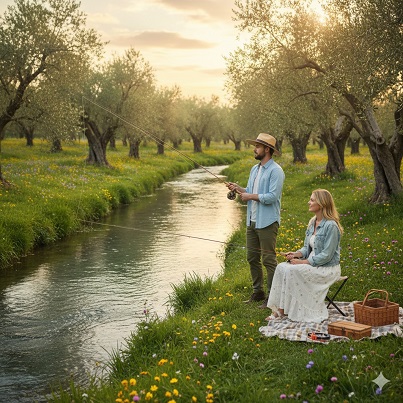
It was in that quiet that the question, which had been circling for months, finally landed.
“We could host more,” Zane said, his voice barely above a whisper, as if not to disturb the peace. “The demand is there. Elena was asking about a monthly farm-to-table series. The NayaJahan network could fill every weekend.”
“Yes,” Lilly replied, just as softly. She leaned her head on his shoulder. “We could. But… should we?”
They brought their notebooks out to the old wooden table under the pergola, where the grape leaves rustled. By the light of a single solar-powered lantern, they began not to plan, but to listen—to themselves.
Zane wrote:
Lilly wrote:
Later, Giuse materialized from the twilight, as he often did, a shadow becoming a friend. He read their silence before they spoke. He placed a gnarled hand on the table, over their notebooks. “Non confondere la crescita con il significato,” he murmured. Do not confuse growth with meaning. “A tree’s worth is not only in its highest branch, but in its deepest root. The branches reach because the roots are sure. First, know your ground. Then see what you wish to touch.”
His words were the final key. They didn’t need to choose between a quiet hermitage and a bustling eco-resort. They could design something in the wise middle.
They decided:
When they told Carmelo their plan, he grunted in approval. “Less chaotic scheduling means less last-minute wiring. My heart approves.” Calogero, for once, didn’t mention clouds. “A balanced load is best for the batteries,” he said, giving a succinct metaphor for life itself.
That night, before sleep, Lilly wrote a single line in the front of their shared journal:
“This land is not a project to be completed. It is a relationship to be tended.”
They slept more deeply than they had in months.
The initial sprint of survival is over. Now you face the marathon of a life. This chapter is about defining the pace and the path that will sustain you, not just your farm.
1. The Three Pathways: A Spectrum, Not a Ladder
There is no “right” or “advanced” choice. There is only the right-for-you choice.
Path A: The Deep Roots (Quiet Continuity)
Path B: The Careful Canopy (Balanced Expansion)
Path C: The Giving Grove (Mentorship & Legacy)
2. The Core Assessment: Your Personal Energy Budget
This is the most important audit you will ever conduct.
3. The Legacy Document: A Letter to Your Future
This is not a legal will, but a philosophical one. It’s a compass for you now, and a gift to your community or successors later.
What to Include:
Its Power: This document aligns your daily choices with your deepest values. It turns a lifestyle into a legacy.
Follow this flow to move from vague feeling to clear intention:
☐ Conduct a Solo & Partner “Energy Audit.” List your top 3 energizing and 3 draining activities related to the homestead.
☐ Draft Your “Pathway Pitch.” In one paragraph, describe your ideal long-term life here 5 years from now. Read it aloud. Does it feel true or exhausting?
☐ Define One Clear Boundary. Example: “No check-ins on Sundays,” or “We host a maximum of two workshops per month.”
☐ Write the First Page of Your Legacy Document. Start with: “The most important thing about this land is…”
☐ Schedule an Annual Review. A dedicated weekend each year to revisit this chapter and reassess. Your path can evolve.
Which long-term pathway is characterized by a primary focus on privacy, self-sufficiency, and minimal engagement with commercial or guest activities?
A. Careful Expansion.
B. Quiet Continuity. ✅
C. Mentorship & Legacy.
D. Commercial Scaling.
Why is a honest assessment of your personal energy and capacity the critical first step in choosing a long-term path?
A. To impress potential investors with your rigorous planning.
B. To ensure you build a sustainable life that avoids burnout and aligns with your authentic self, not an idealized fantasy. ✅
C. Primarily to calculate how quickly you can grow your income.
D. It’s an optional exercise for those who are overly analytical.
What is the primary purpose of creating an informal “Legacy Document”?
A. To create legally binding obligations for future owners.
B. To clarify and codify your core values and intentions for the land, serving as a guiding compass for your decisions and a message for the future. ✅
C. To replace formal business and estate planning.
D. To generate social media content about your philosophy.
To go to the next lesson, click Next.