Journey of a Thousand Dreams
[ Chapter 1-5 ] [ Chapter 6-10 ] [ Chapter 11-15 ] [ Chapter 16-end ]
A Story of Leaving Everything and Finding a New World – by Anon -14Feb2026
(to take a hands-on experience of this story, you may take the Living Off-Grid in Sicily program).
PROLOGUE
A heart desire, mapped in the minds
This is the story of Zane and Lilly, whispered between the two, who had everything except the one thing they needed most: a place to call their own… It is a story of passion, pursuit, passports, permits, of stone walls, solar panels, and of sheep who refuse to be trained and chickens who judge your life choices. It is a story of mistakes made in public and lessons learned in private, of friendships forged frustration and meals that tasted like triumph.
But mostly, it is a story about what happens when you stop asking what if and start asking why not.
So settle in. Find a quiet corner, and read their story.
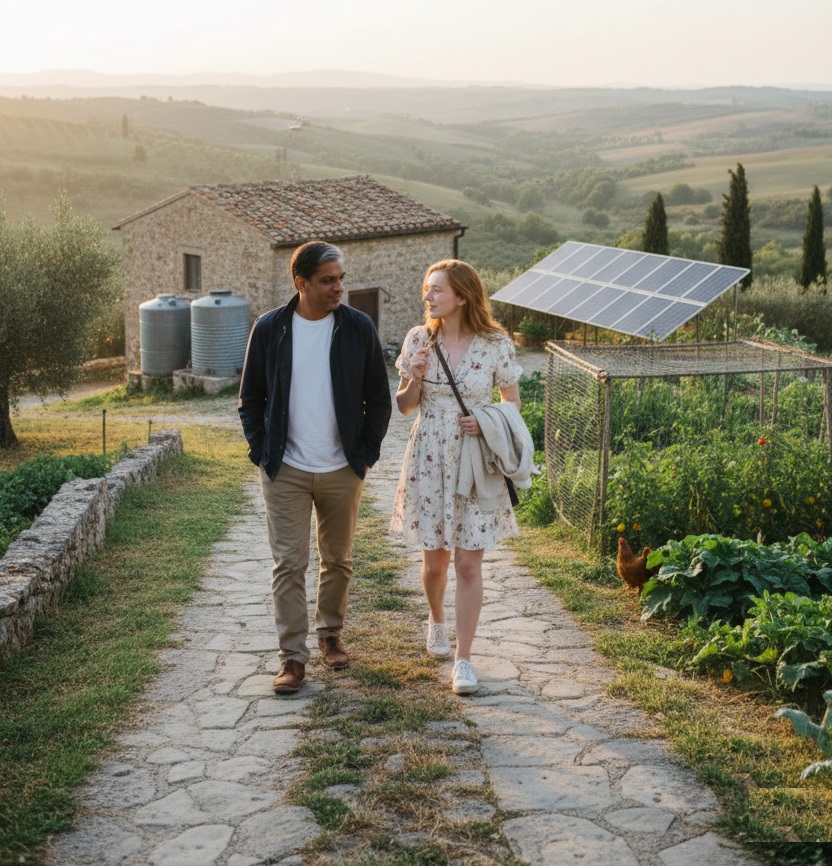
The sun is rising over Sicily, in Italy and somewhere in the hills of Mussomeli, a couple is walking their land, checking their water tanks, and marveling that this impossible, improbable, glorious life is actually, finally, undeniably theirs.
This is their beginning.
And perhaps, if you listen closely, it is yours too.
PART ONE
The Before
CHAPTER 1
The Brochure, the Mall, and the Pathan Who Couldn’t Look Away
The monsoon rain hammered Karachi like it had a personal grievance against the city, turning Do Talwar into a river of brake lights and frustrated horns. Inside Dolmen Mall, however, the world was air-conditioned and orderly—a bubble of privilege floating above the flooded streets.
Zane Khan was not supposed to be here.
He was supposed to be at his law chambers, reviewing a corporate merger that would make rich men richer and leave him with billable hours and a hollow feeling he couldn’t quite name. But his cousin Sam had insisted. “Yaar, one hour. Sabir needs help picking a suit for his engagement, and you have taste. Unlike these barbarians I call relatives.”
So here Zane stood, full of Pathan stubbornness wrapped in a charcoal linen kameez, watching Sabir model a series of increasingly disastrous sherwanis while Sam made inappropriate comments through a mouthful of popcorn from the food court.
“She’s looking at you,” Sam muttered, elbowing Zane’s ribs.
“Everyone is looking at Sabir. He’s wearing sequins.”
“No, the girl. By the juice counter. Blonde. American. Distributing something.”
Zane turned, intending only a brief, dismissive glance.
It was not brief.
She stood at a small folding table draped in bright blue cloth, handing pamphlets to reluctant shoppers. Her hair—the colour of wheat in the Peshawar autumn—was pulled back in a practical ponytail. She wore a simple shalwar kameez in dusty rose, completely unselfconscious, as if she had been wearing Pakistani clothes her entire life rather than—what? A few months? A year?
She laughed at something an elderly woman said, and the sound cut through the mall’s ambient noise like a shaft of light through storm clouds.
“Go talk to her,” Sam urged.
“I don’t even know what she’s selling.”
“It’s not selling, it’s distributing. There’s a difference. Go. Be useful. Take a pamphlet.”
Zane found himself walking toward the blue table before his brain could veto the idea.
“Hello,” he said. Then, brilliantly: “What are you distributing?”
She looked up, and her eyes were the exact colour of the Arabian Sea on a clear morning. “Information about the PCCF School for Deaf Children. We’re a nonprofit. Free education, vocational training, hearing aids for families who can’t afford them.” She handed him a pamphlet with a smile that was neither performative nor rehearsed. It was simply… warm. “I’m Lilly.”
“Zane.” He took the pamphlet, though he wasn’t seeing the words. “You’re American.”
“North Dakota.” She said it like a confession. “But I’ve been here eight months now. Volunteering. Learning Urdu. Eating too much nihari.”
“Eight months and you’re already wearing shalwar kameez without tripping over the dupatta. Impressive.”
She laughed again. “There was a learning curve. Ask me about the time I tried to ride a rickshaw in a lehenga.”
“I absolutely will. When is your next break?”
Three hours later, they were sitting on the seawall at Clifton, the storm having moved inland, leaving behind a sky of improbable pink and gold. Zane had bought her kulfi from a vendor whose cart had miraculously survived the rain, and Lilly had somehow convinced him to try the spiciest chaat she could find.
“My grandmother would say you’re trying to kill me,” Zane gasped, reaching for his mango lassi.
“Your grandmother sounds wise. Also, you’re clearly not dying. Pathan resilience.” She grinned, entirely unrepentant.
“How do you know I’m Pathan?”
She tilted her head, considering. “The posture. The pride. The way you say ‘yaar‘ like it’s both an insult and an endearment. Also, Sam told me while you were buying the kulfi.”
“Sam talks too much.”
“Sam is an excellent wingman.”
Zane looked at her—really looked—and felt something shift in the architecture of his carefully planned life. “So, Lilly from North Dakota. What made you leave America for a school in Karachi?”
She was quiet for a moment, watching the waves. “My younger brother, Caleb, was born with severe hearing loss. When we found out, my parents didn’t know where to start. The right doctors, the right therapists, the right school—it was a maze. We were lucky. We had resources, insurance, family support.
But I kept thinking about the families who don’t have any of that. The kids who fall through the cracks.” She shrugged, a small, self-conscious movement. “So I studied special education. And then I found PCCF, and they needed volunteers, and here I am.”
“Caleb—is he okay?”
“He’s seventeen now. Plays basketball. Argues with our parents about curfew. Wants to be an architect.” Her smile was soft, private, full of love. “He’s more than okay.”
“Alhamdulillah,” Zane said, without thinking.
Lilly looked at him, and something flickered in her expression—recognition, perhaps, of a language she was learning to speak. “Alhamdulillah,” she repeated carefully. “Is that right?”
“Perfect.”
She smiled, and the kulfi melted, and the sky turned to amethyst, and Zane Khan—corporate lawyer, MBA, son of Peshawar—made a quiet, desperate wish that this moment would never end.
CHAPTER 2
Squash, Saag, and the Education of Zane Khan
The squash courts at the Karachi Gymkhana became their neutral territory.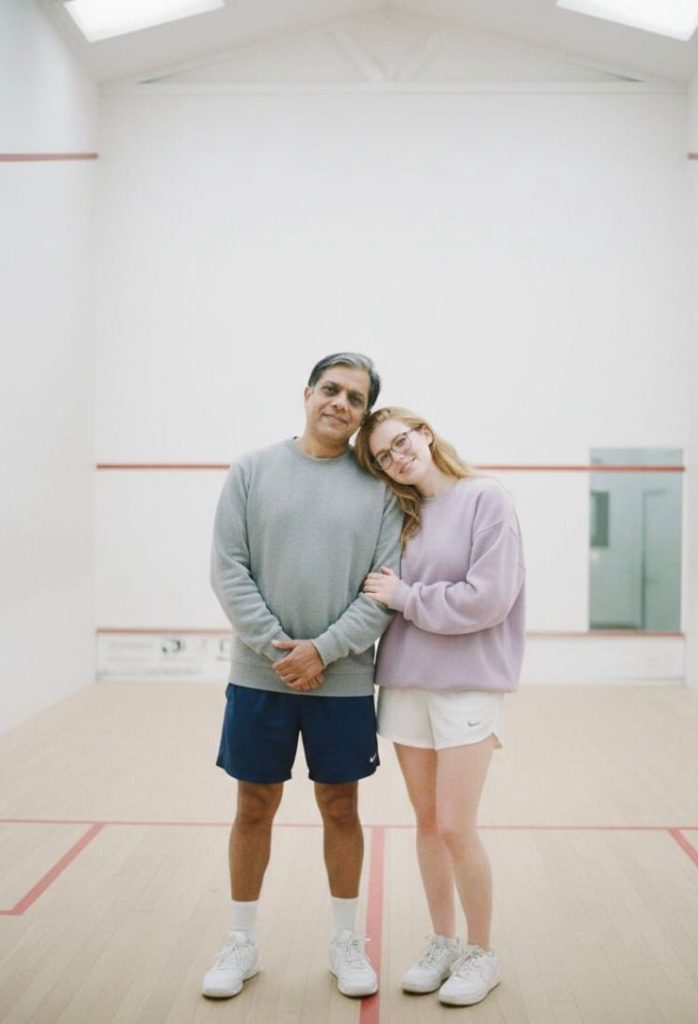
Twice a week, Zane would pick Lilly up from the small apartment she shared with another PCCF volunteer, a sharp-witted Afghan-Pakistani woman named Zakkiya who worked as a speech therapist. Zakkiya took one look at Zane’s starched kameez and his careful, courtly manners and pronounced him “tragically predictable but salvageable.”
“Don’t let her scare you,” Lilly whispered as Zakkiya closed the door behind them. “She does this thing where she pretends to be intimidating, but she cries at Coke Studio videos.”
“I heard that!” Zakkiya’s voice floated through the door. “And it’s not just Coke Studio! Kuch Ankahi reruns also count!”
Zane discovered that Lilly played squash like she did everything else: with fierce concentration, complete lack of ego, and surprising physicality. She had no interest in letting him win.
“That’s game,” she announced, her fourth victory in a row. “You’re getting better, though.”
“You’re humouring me.”
“A little.” She towelled her face, flushed and triumphant. “But only a little. You’ve got good instincts. You just think too much.”
“That’s my job.”
“Then maybe you need a different job.”
The words hung in the air, unexpected. Zane busied himself with his squash racket. “My family expects—”
“I know.” Her voice was gentle.
“I’m not saying it’s easy. I’m just saying it’s worth asking.”
Sam and Sabir, who had formed an unofficial cheering section/commentary team, were waiting at the juice corner. With them was Rose, Sabir’s fiancée, a paediatrician with a laugh like wind chimes and a gift for putting everyone at ease. She was the only person who could make Sam blush.
“So?” Rose asked, sliding a glass of fresh sugarcane juice toward Lilly. “How many times did you destroy him today?”
“Four.”
“Respect.”
Sam grabbed Zane’s shoulder. “Brother, you need a new strategy. She’s reading your backhand like a newspaper.”
“My strategy is fine.”
“Your strategy is admiring her form while she’s scoring points. That’s not a strategy. That’s a prayer.”
Lilly choked on her juice. Zakkiya, who had materialized at their table with the unsettling silence of a cat, passed her a napkin. “He’s not wrong.”
Zane, who had survived Peshawar’s bar exams and negotiated contracts in three languages, found himself completely incapable of forming a coherent response.
Rose took pity on him. “Leave him alone. Can’t you see he’s suffering beautifully?”
They teased him mercilessly. But that evening, as Zane drove Lilly back through streets strung with fairy lights for Eid, she reached across the centre console and placed her hand on his.
“I like your friends,” she said.
“They’re idiots.”
“Yes. But they’re your idiots. That’s the important part.”
He turned his hand over, interlacing their fingers. “Lilly—”
“I know. We should talk about it properly. What this is, what we’re doing, what happens when my volunteer term ends in six months.” Her voice was steady, but her grip tightened. “I just… I don’t want to rush. Whatever this is, it feels important. I don’t want to break it by trying to name it too soon.”
Zane lifted her hand to his lips, a gesture so old-fashioned it belonged to another century. “Then we don’t name it. Yet.”
“But you’ll still come to squash?”
“Every Tuesday and Thursday. And Sunday, if you’re free.”
“I’m free.” Her smile was radiant. “I’m always free for you.”
CHAPTER 3
The Eucalyptus Lesson
It was Sabir who suggested the tree-planting.
“Aren’t you two tired of malls and juice corners?” he announced one Friday evening, sprawled across Rose’s sofa while she marked patient files. “Go do something useful. Plant trees. Save the planet. Be disgusting about it in nature.”
“The mangroves are all the way in Karachi,” Zane protested.
“I’m not talking about mangroves. There’s a community farm in Korangi. They’re planting eucalyptus for windbreaks. My cousin runs the project. I’ll text you the address.”
And so, on a Saturday morning that dawned impossibly hot, Zane and Lilly found themselves in a field of dusty earth, surrounded by saplings and volunteers and one extremely enthusiastic project coordinator named Mark.
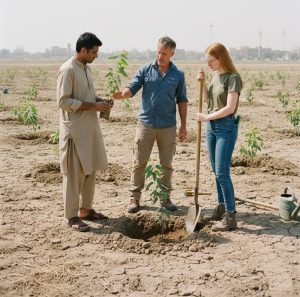 Mark was Australian, which explained both his enthusiasm and his wardrobe of cargo shorts and a faded AC/DC t-shirt. He had been in Pakistan for six years, spoke Urdu with a terrible accent and absolute confidence, and approached tree-planting with religious fervour.
“Right, you two,” he said, thrusting a shovel at Zane. “Dig hole. Depth thirty centimetres. Not forty, not twenty. Thirty. Trees are like people—put them in the wrong depth, and they spend their whole lives trying to adjust.”
Lilly knelt in the dirt without hesitation, her jeans already dust-covered, her face shaded by a wide-brimmed hat she’d bought from a roadside vendor for two hundred rupees. “How far apart should they be?”
“Three metres minimum.
They need room to grow.”
“Like people,” Lilly said, and her eyes met Zane’s across the sapling.
Mark, oblivious to subtext, launched into a detailed explanation of soil composition. Zane dug. Lilly planted. They worked in companionable silence, passing water back and forth, their shadows lengthening across the new rows of hopeful green.
By late afternoon, Zane’s hands were blistered, his back ached, and his kameez was ruined. He had never been happier.
“There,” Lilly said, surveying their row of twenty-three eucalyptus saplings. “They look like soldiers.”
“Disorganized soldiers. The third one is leaning.”
“It’s not leaning. It’s thinking.”
Mark wandered over, assessing their work with a critical eye. “Not bad for beginners. You’ve got good instincts.” He squinted at Zane. “You a lawyer or something?”
“How did you know?”
“The way you hold the shovel. Like it’s a brief you’re trying to win.” Mark grinned. “Don’t worry. Trees are easier than people. They only need four things: sun, water, soil, and time.”
“What about the fifth thing?” Lilly asked.
“Patience.” Mark wiped his forehead with his sleeve. “But that’s not for the trees. That’s for ….. you.”
CHAPTER 4
The Question
Six months became eight.
Lilly extended her volunteer term. Zane took fewer corporate cases and started doing pro bono work for refugee families. Sam got engaged to a textile designer named Ayesha. Sabir and Rose married in a ceremony that lasted three days and required five different outfits, and Zakkiya cried through all of it, including the Nikkah, the Valima, and a surprisingly emotional toast involving mangoes.
Through it all, Zane and Lilly built their strange, beautiful life in the interstices of their obligations. Tuesday squash. Saturday tree-planting. Thursday night dinners at Burns Road, working their way through every famous eatery. Weekend picnics at the beach, where they collected shells and watched the sun dissolve into the Arabian Sea.
Sometimes Zane’s mother called from Peshawar and asked, with studied casualness, whether he had met any “suitable girls.” Zane would deflect, change the subject, promise to visit soon. He never mentioned Lilly. Not because he was ashamed—he had never been less ashamed of anything in his life—but because he didn’t yet have the words to explain her to a woman who had spent sixty years imagining her son’s future with a Pathan bride from a good family.
Lilly, for her part, had her own negotiations. Her parents in Fargo had seen photos, heard stories, and were navigating their own steep learning curve.
“They’re not opposed,” Lilly said one evening, curled on Zane’s balcony, watching the city glitter below. “They just… they don’t understand why I’d choose a life so far away from everything they know.”
“Do you regret it?”
She considered the question with characteristic honesty. “No. But I wish they could see what I see. This city. These people. You.” She looked at him, and her eyes held the same sea-colour he’d first seen in a crowded mall. “Zane, I need to ask you something.”
His heart stopped. “Yes.”
“You don’t even know what I’m going to say.”
“Doesn’t matter. The answer is yes.”
She laughed, but her voice trembled. “When my term ends this time, I have to go back. My visa, my family—I can’t keep extending forever. And I need to know if this is…” She took a breath. “Are we building something temporary, or are we building something that lasts?”
Zane put down his tea. He turned to face her fully, the city noise fading to a distant hum. “Lilly. Listen to me carefully.”
She nodded, her hands clasped tight in her lap.
“I am a Pathan from Peshawar. My family has lived in the same valley for four hundred years. We are not a people who leave easily. We are not a people who choose lightly.” He took her hands, unclasped them, held them between his own. “And I have never, in my entire life, been as certain of anything as I am of you.”
Tears spilled down her cheeks, but she was smiling. “That’s very romantic. Also, you still haven’t answered my question.”
“I want to marry you.”
“Okay. Good. Because I want to marry you too.”
“And I want to build something that lasts.”
“Okay.”
“And I want—” He stopped. The word caught in his throat, enormous and terrifying. “I want children. With you. Who will be half-Pathan and half-American and wholly themselves, and who will grow up knowing that love doesn’t have to look like what anyone else expects.”
Lilly was properly crying now. “Zane. That’s the most beautiful thing anyone has ever said to me.”
“Is that a yes?”
“That’s a yes. That’s a thousand times yes.”
Later, after they had called both families and weathered the shock, the questions, and—eventually—the cautious blessings, Zane stood alone on his balcony. The city pulsed below, indifferent to his joy. Somewhere in North Dakota, Lilly was talking to her mother, her voice crackling through thousands of miles of satellite and sea.
He thought of the eucalyptus trees they had planted, now waist-high and stubbornly alive despite the odds. He thought of Mark’s voice: Sun, water, soil, and time. And patience. Patience for the trees, but mostly for yourself.
Zane Khan, corporate lawyer, MBA, son of Peshawar, looked up at the stars and made a wish he had never dared to make before.
Let me be worthy of this life we’re building.
PART TWO
The Crossing
CHAPTER 5
The Map
Their wedding was neither small nor large, but something in between—a bridge between two worlds that neither fully claimed them.
In Peshawar, at their Al-Zain bungalow, Zane’s mother draped Lilly in gold and wept into her dupatta. His sisters danced all night. And his father, the ‘Sun’ of their family, flawlessly dressed, hugged Zain and said, “Zindagi ye kaisi hai? Jaisay jio waisi hai!” Hope is how life is built. He gifted Zane, his favourite car Mazda929 (PRE30).
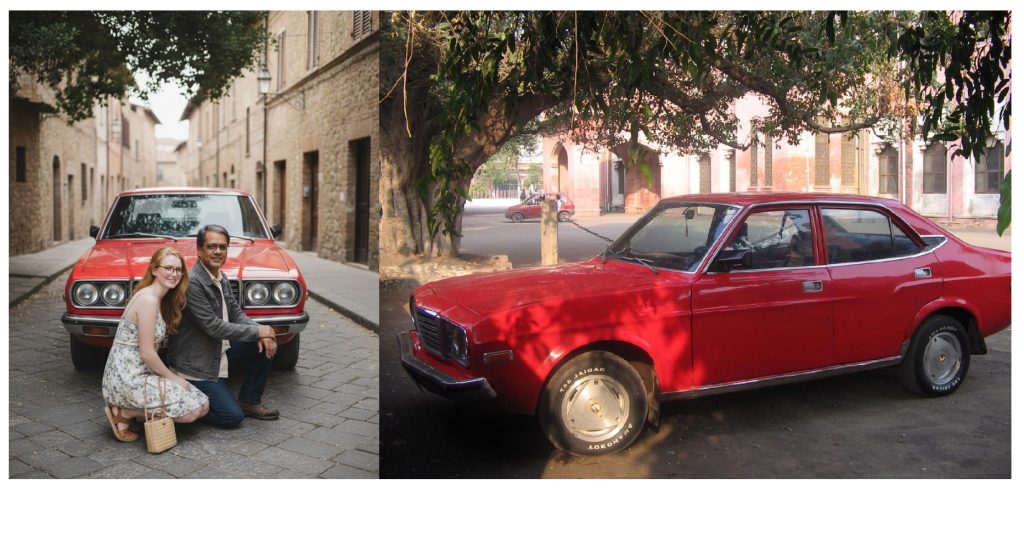
In Fargo, Lilly’s parents hosted a reception at the Lutheran church, and Zane endured endless photographs and his first-ever Jell-O salad with the stoic dignity of a man who had negotiated with armed factions. Lilly’s brother Caleb, now eighteen and heading to architecture school, pulled Zane aside and said, “If you hurt her, I will find you. I have very good design software.”
Zane promised he would not need to be found.
They returned to Karachi as a married couple, to an apartment that was suddenly theirs in a way it hadn’t been before. The squash rackets hung side by side in the entryway. A framed photo of their eucalyptus trees—now taller than both of them—occupied pride of place above the dining table.
And yet.
Something had shifted. The life they had built—the good work, the dear friends, the rhythm of days—felt suddenly, inexplicably, too small.
It was Sam who voiced it first, over chai at his own engagement celebration. “You two look like you’re waiting for something.”
“Everyone’s always waiting for something,” Zane said.
“No, I mean it. You look like passengers on a train that hasn’t left the station.” Sam leaned forward. “What are you waiting for?”
Lilly and Zane looked at each other. Neither spoke.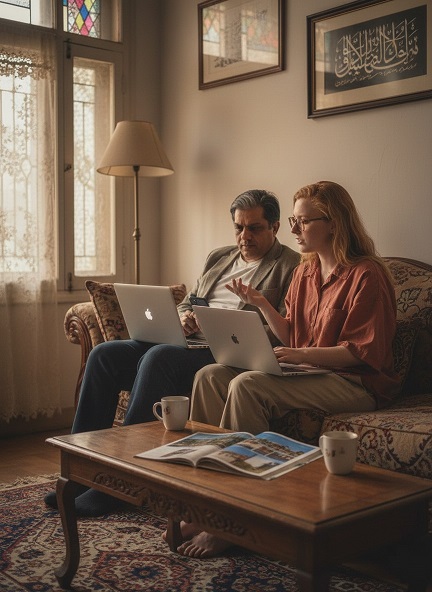
That night, lying awake in the dark, Lilly said, “I dreamed about a hill.”
“What kind of hill?”
“I don’t know. It was green. There were trees I didn’t recognize. And a house—just stones, really. Ruins. But the light was beautiful.” She paused. “I woke up and I couldn’t remember where I was.”
Zane pulled her closer. “It was just a dream.”
“I know.” But her voice was troubled. “Zane, do you ever feel like we’re supposed to be somewhere else?”
He didn’t answer. Because he did feel it—a restlessness that had no name, a pull toward something he couldn’t articulate. It wasn’t dissatisfaction with their life. It was the sense that their life, as full and good as it was, was waiting for its true shape to emerge.
The next morning, Zane opened his laptop and typed three words into the Google search bar:
Buy land Italy…
[ Chapter 1-5 ] [ Chapter 6-10 ] [ Chapter 11-15 ] [ Chapter 16-end ]