Journey of a Thousand Dreams
[ Chapter 1-5 ] [ Chapter 6-10 ] [ Chapter 11-15 ] [ Chapter 16-end ]
(to take a hands-on experience of this story, you may take the Living Off-Grid in Sicily program).
CHAPTER 6
The Possibility
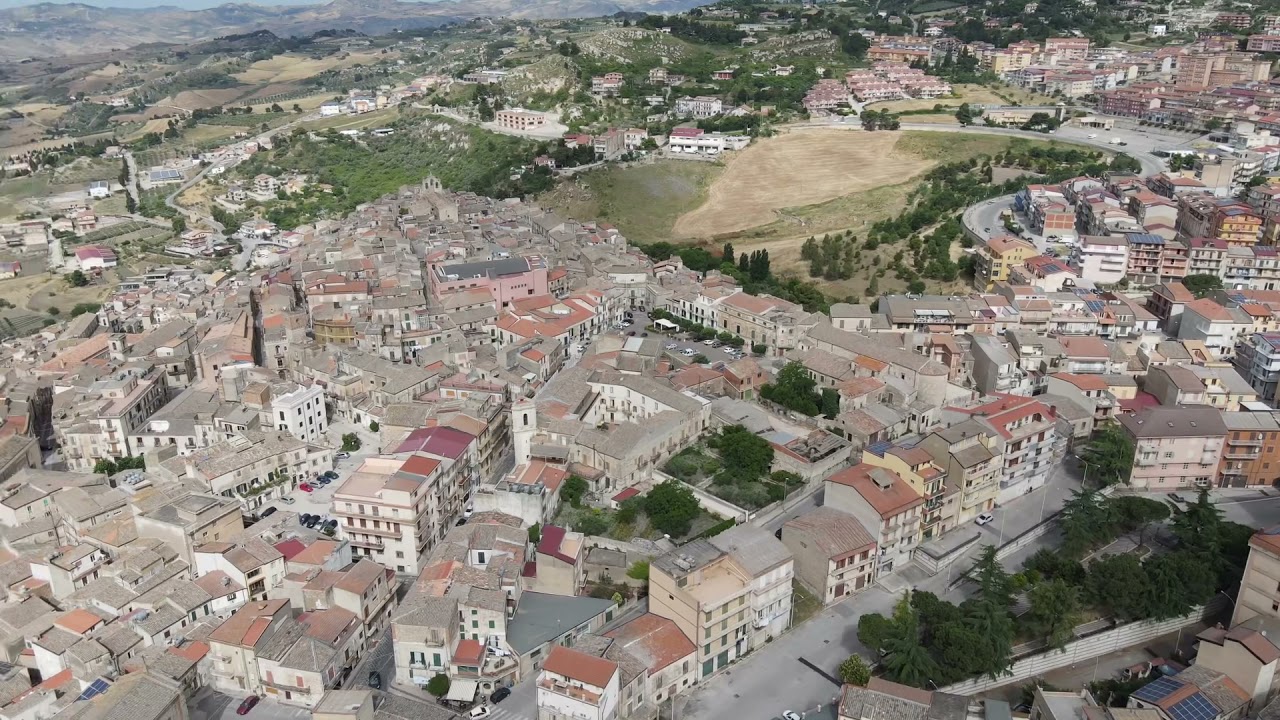
The first article he read was about one-euro homes in a town called Mussomeli.
It sounded like fiction. Entire houses, abandoned when the young people left for cities and the old people passed on, available for the price of a cup of coffee. The catch, of course, was the renovation—decades of neglect, roofs collapsed, walls crumbling, infrastructure nonexistent.
But there was also land. Agricultural land, terraced into hillsides, dotted with ancient olive trees that had witnessed empires rise and fall. Land that could be bought by foreigners, even non-EU citizens, as long as their countries had reciprocity agreements with Italy.
Pakistan did. America did.
Zane closed the laptop and sat very still.
He found Lilly at the PCCF school, helping a group of children prepare for their annual art exhibition. She was sitting on the floor, surrounded by construction paper and glitter glue, her hair escaping its ponytail, her concentration absolute. A little boy with cochlear implants was showing her his painting—a house on a hill, green trees, yellow sun.
“Zane.” She looked up, surprised. “What are you doing here?”
“I need to show you something.”
He drove her home in silence, her questions unanswered. At the apartment, he opened the laptop, pulled up the article, and stepped back.
Lilly read. Her face was unreadable.
“Sicily,” she said.
“Yes.”
“Italy.”
“Yes.”
“This isn’t one of Sam’s pranks?”
“No.”
She read for another minute. Then she closed the laptop, sat on the edge of the sofa, and started to laugh.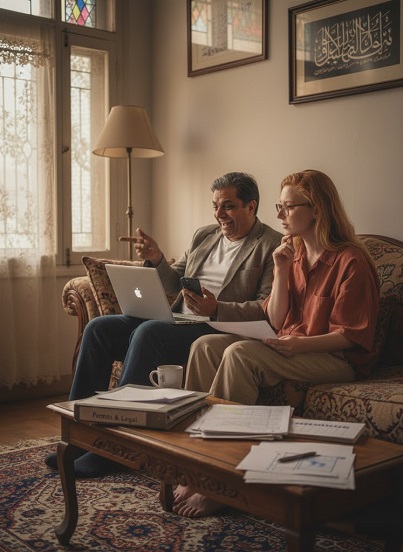
“Lilly? Are you okay?”
“I’m trying to remember,” she said, wiping her eyes, “if I ever specifically told God that I wanted to marry an insane person who randomly decides to move to Sicily.”
“Is that a no?”
“That’s a—” She took his hand, pulled him down beside her. “That’s a ‘tell me everything.'”
So he did. Not just the one-euro homes, but the agricultural land, the off-grid potential, the climate, the cost of living, the visa pathways. He talked for an hour, his words tumbling over each other, and Lilly listened with the focused attention she brought to everything important.
When he finally stopped, she said, “You’ve really thought about this.”
“I’ve been thinking about it for weeks.”
“Why didn’t you say anything?”
“Because I didn’t know if it was real. I didn’t know if I was just—escaping.”
She took his face in her hands, the way she always did when she needed him to really hear her. “Zane. You’re the least escapist person I know. You don’t run away from things. You run toward them.” Her thumb traced his cheekbone. “So. Sicily.”
“So. Sicily.”
“We should visit. Before we do anything crazy. Just to see if it feels like… like what we’re looking for.”
“And if it does?”
She smiled. “Then we start building a different kind of life.”
CHAPTER 7
The First Look
They landed in Palermo on a Sunday in July, the air thick with jasmine and salt.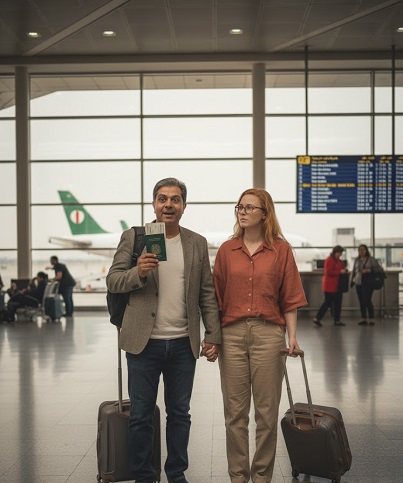
Sam had insisted on coming. “Someone has to document this madness. Also, Zakkiya wants to make sure you don’t buy a swamp.” Zakkiya, busy with a speech therapy conference, had settled for exhaustive briefing documents and a stern warning about real estate agents.
Their AukSun portfolio manager, Marco, met them at the airport. He was calm, precise, and utterly unromantic about the entire enterprise—which, Zane realized, was exactly what they needed.
“You will fall in love with the first property you see,” Marco said as he drove them toward Mussomeli. “Everyone does. The light, the hills, the romance of ruin. But falling in love and buying property are different things. One requires your heart. The other requires your lawyer.”
“I am a lawyer,” Zane said.
“Good. Then you understand.”
The road curved through wheat fields and olive groves, past hilltop towns that seemed to grow organically from the stone. And then Mussomeli appeared—a cascade of golden buildings tumbling down a hillside, crowned by the dark silhouette of a Norman castle.
Lilly pressed her face to the window. “Oh,” she breathed. “Oh, Zane.”
He knew exactly what she meant.
Their first property viewing was, as Marco predicted, a disaster of beauty. An abandoned farmhouse with a collapsed roof, surrounded by olive trees so ancient their trunks were twisted into impossible shapes. The agent spoke rapidly in Sicilian dialect, pointing at this and that, while Marco translated with diplomatic restraint.
“The roof is gone. The walls are structurally compromised. There is no water, no electricity, and the access road is—” He paused, searching for the right word. “—aspirational.”
“How much?” Zane asked.
Marco named a figure. It was less than they had spent on their wedding.
Lilly walked among the olive trees, her hand trailing over bark that had survived centuries of drought, war, and abandonment. Zane watched her from the ruined doorway.
“What are you thinking?” he called.
She turned, her face lit by the golden light. “I’m thinking Mark was right.”
“About what?”
“About trees. Sun, water, soil, and time.” She spread her arms, encompassing the land, the hills, the impossible dream. “I think this place has been waiting for someone to give it that.”
They didn’t buy the first property. Marco insisted on showing them seven more over four days, each with its own complications and charms. They saw a converted stable with excellent bones but no land. They saw agricultural terrain with perfect southern exposure but no structure. They saw a legal ruin with a neighbour who, upon their arrival, emerged from his own property wielding a shotgun and delivered a ten-minute harangue about property boundaries.
(“He’s not angry at you,” Marco explained. “He’s angry at the previous owner, who died in 1998. The boundary dispute is metaphorical now.”)
On their final evening, exhausted and overwhelmed, they sat on the terrace of their agriturismo, watching the sun set over the Valle del Platani.
“I don’t know,” Lilly said. “Everything blurs together. Beautiful hills, crumbling walls, friendly agents, angry neighbours with shotguns. I can’t tell what’s real anymore.”
Zane was quiet for a long time. Then: “What about the first one?”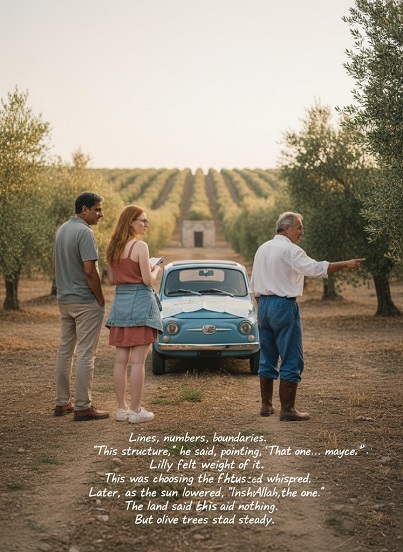
“Which first one?”
“The ruin. With the olive trees. And the aspirational road.”
Lilly turned to look at him. “You remember it.”
“I haven’t stopped thinking about it.”
She smiled, slow and wondering. “Neither have I.”
CHAPTER 8
The Promise
The second visit was different.
They came in October, when the harvest season painted the hills in gold and amber. They brought Giuse Inglese, a mason Marco had recommended, whose face was weathered as the stone he worked and whose silence was more eloquent than most men’s speeches.
Giuse walked the property for forty-five minutes without speaking. He tapped walls, crouched to examine foundations, ran his fingers over mortar that had crumbled to dust. Zane and Lilly hovered at the edge of the olive grove, trying to read meaning into his impassive expression.
Finally, he straightened. “Buone ossa,” he said.
“Good bones,” Marco translated.
Giuse looked at Zane. “The house wants to live again. You must decide if you want to be the one who helps it.”
“How long would it take?” Zane asked.
Giuse shrugged, a gesture that contained multitudes. “A house is not a project. It is a conversation. Some conversations take years.”
“And the cost?”
Another shrug. “More than you think. Less than you fear.”
Lilly stepped forward. “Can you help us? If we decide to do this?”
Giuse studied her for a long moment—her earnest face, her dusty boots, the calluses forming on her hands from their weeks of learning. “You are not afraid of work?”
“I’m afraid of waking up in twenty years and wishing I had tried.”
Something shifted in his expression. Respect, perhaps. Recognition. “Then I will help you.”
That evening, Zane and Lilly walked the boundary of their future land, tracing the line where their responsibility would begin and the wild world would end. The olive trees stood sentinel, indifferent to the weight of human dreams.
“Giuse said the house wants to live again,” Lilly said. “Do you feel it?”
Zane stopped, turning slowly, trying to absorb the land through his skin. “I feel… possibility. Not certainty. Not yet.”
“That’s honest.”
“I’m trying to be. With you, with this—I don’t want to pretend I know what I’m doing.”
Lilly took his hand. “Good. Because I definitely don’t know what I’m doing. But I know I want to do it with you.”
The moon rose, silvering the olive leaves. Somewhere in the valley, a dog barked, and another answered. The house—their house, if they chose it—stood silent, waiting for its resurrection.
“Alhamdulillah,” Zane whispered.
“InshaAllah,” Lilly replied.
And the land, which had waited centuries, settled into patient expectation.
PART THREE
The Becoming
CHAPTER 9
Stone and Patience
The first six months were an education in humility.
They had returned to Karachi to sell the apartment, wind down Zane’s practice, and endure the collective anxiety of their families and friends. Sam had been appointed official Worry Coordinator, a role he embraced with characteristic dramatics. Zakkiya compiled an emergency binder containing everything from visa regulations to Sicilian curse words. Rose supplied a comprehensive first-aid kit and made them both promise to video call at least twice a week.
“Pakistan isn’t going anywhere,” Sam said at their farewell dinner, his voice deliberately light. “And neither are we. So if this Sicily thing doesn’t work out, you just come home. No shame. No questions.”
“There will be questions,” Sabir muttered.
“Only from me, and only after an appropriate interval of dignified silence.”
“You’ve never been silent in your life.”
“I’ll learn. For Zane.”
They had laughed, hugged, promised to stay in touch. And then they were on a plane, watching Karachi shrink to a glittering map below, and then disappear entirely into cloud.
Now, standing in the shell of their farmhouse while Giuse patiently explained why the wall they had attempted to repoint was fundamentally wrong, Zane wondered if his ancestors had felt this same combination of determination and despair when they first crossed the Khyber Pass.
“The mortar,” Giuse said, not unkindly. “You mixed it too wet. For modern bricks, this is fine. For old stone, it suffocates.”
“Suffocates the stone?”
“Suffocates the house. Stone breathes. It needs lime, not cement. It needs patience, not speed.” He knelt, demonstrating with slow, deliberate movements. “Like this. Small batch. Feel the texture. Wait for it to tell you when it’s ready.”
Zane tried again. This time, Giuse nodded.
“Better. The house is teaching you.”
“The house is humiliating me.”
“Same thing.”
Lilly, meanwhile, had discovered her own teacher. Zina, Giuse’s wife, arrived on their second week with a basket of tomatoes and a mission to civilize these strange foreigners.
“You cook?” she asked Lilly, inspecting the bare kitchen.
“Basic things. Dal, sabzi, rice.”
“Pakistani food.” Zina nodded approvingly. “Spices are good. But Sicily has its own language of flavour. Come.”
Thus began Lilly’s education in the art of Sicilian cooking: the precise ratio of garlic to olive oil, the secret to sauce that tasted of summer, the patience required to coax flavour from simple ingredients. She learned to make caponata that made Zina’s cousin—a notoriously harsh critic—grunt with reluctant approval. She learned to bake bread that emerged from their wood-fired oven with a crust that shattered perfectly.
“Cooking is like building,” Zina told her one afternoon, as they preserved tomatoes in golden oil. “You cannot rush. You cannot force. You listen to the ingredients, you respect the tradition, and you add your own story.”
“What’s my story?” Lilly asked.
Zina considered. “You are here. That is story enough.”
CHAPTER 10
Komal
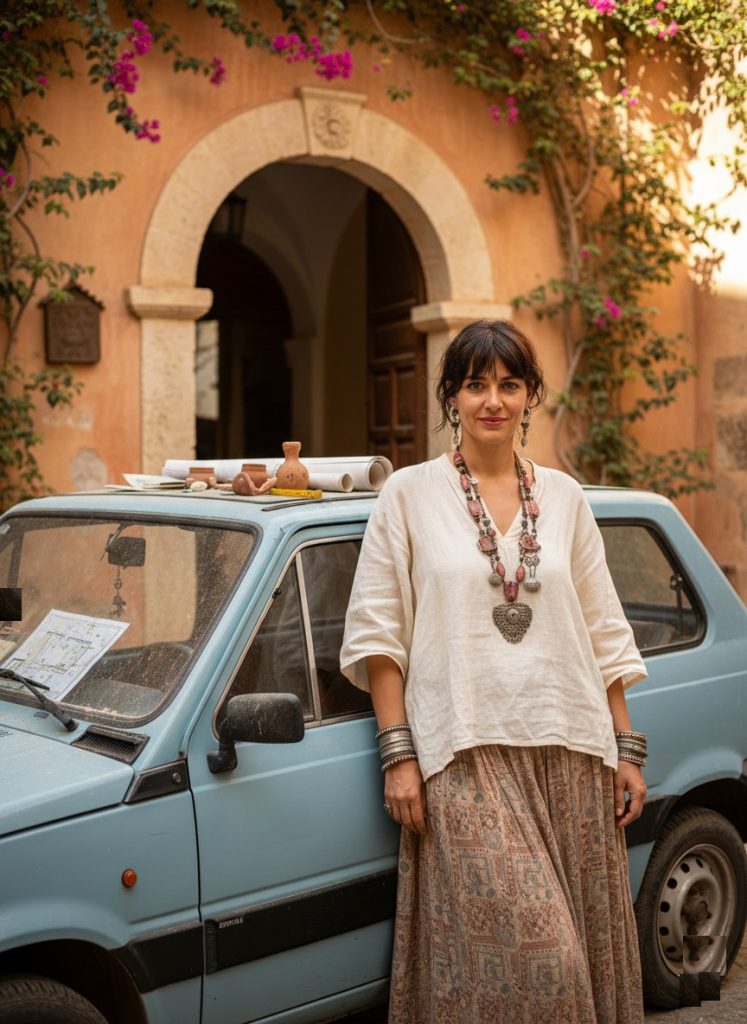
Komal arrived in March, when the almonds were blooming and the rains had finally stopped.
Komal was, by her own description, “a professional house-bringer-backer-to-life.” She had spent twenty years restoring period properties in Pakistan, followed by five years in U.K., followed by a pandemic-induced sabbatical that somehow led her to a crumbling palazzo in Mussomeli.
Marco had suggested she might consult on their interior finishes. “She knows more about traditional lime plaster than anyone south of Rome. Also, she’s available. Her palazzo project is stalled while they argue about a fifteenth-century fresco.”
Komal drove a battered Fiat Panda that smelled of coffee and plaster dust. She was forty-two, with dark hair cropped loosely to her head and eyes the colour of winter sea. Her handshake was firm, her opinions immediate, and her laugh—which emerged at unexpected moments—sounded like water over stones.
“You’ve got good bones,” she said, after a ten-minute inspection of their main living space. “The previous owners made some… interesting choices.” She gestured at a wall that had been inexpertly rendered in cement. “But bones are what matter. Everything else is just skin.”
Zane liked her immediately. This was the problem.
It wasn’t romantic—he knew that, Lilly knew that, even Komal herself would have laughed at the suggestion. But there was an ease between them, an instant recognition of kindred spirits, that Zane had rarely experienced outside his marriage. Komal talked about buildings the way he talked about law: as systems of logic and beauty, governed by rules that could be learned but not fully taught. She didn’t explain; she invited. She showed him how to identify original features, read the history in a wall’s stratification, recognize the subtle signatures of different craftsmen.
“The mason who built this arch,” she said, running her fingers along the curve, “he was showing off. Look at the precision, the confidence. He knew the bishop was coming to bless the building. This was his audition for heaven.”
Lilly watched them together, her expression carefully neutral.
At night, after Komal returned to her palazzo, Zane would find Lilly sitting in their half-finished kitchen, tracing patterns in the condensation on her water glass.
“She’s remarkable,” Lilly said one evening. Not a question.
“She knows her craft.”
“That’s not what I mean.”
Zane set down his book. “What do you mean?”
Lilly was quiet for a long time. “You light up when you talk to her. You don’t do that with many people.”
He considered his response carefully. “I light up when I talk to Giuse about stone. I light up when Carmelo explains electrical theory. I light up when Calogero finally stops complaining about clouds and admits that solar systems are beautiful.”
“It’s different.”
“Is it?”
“You know it is.”
He crossed the room, knelt beside her chair. “Lilly. Look at me.”
She did, reluctantly.
“Komal is extraordinary. She’s lived three lifetimes worth of adventure. She’s taught me more in three weeks than I learned in three months of YouTube tutorials. And none of that changes the fact that you are the only person in the world I want to come home to.”
“You come home to me every night.”
“Because you’re my home. Not this house. Not this land. You.”
Her eyes filled, but she was smiling. “That was a very lawyerly argument.”
“I’m a very lawyerly husband.”
“Overruled.”
“Appealed.”
“Denied.” She pulled him into a hug, soft and forgiving. “I’m not jealous. I’m just—learning. How to share you with all these new people who keep appearing.”
“You’re not sharing me. You’re expanding me. There’s a difference.”
“Also very lawyerly.”
“I love you.”
“I love you too. Even when you’re insufferable.”
“Especially when I’m insufferable.”
“Obviously. That’s when you need me most.”
[ Chapter 1-5 ] [ Chapter 6-10 ] [ Chapter 11-15 ] [ Chapter 16-end ]